Car Tint Window Film Electric: The Complete Technical Guide to Dynamic Automotive Glazing
The automotive industry is experiencing a fundamental shift in how vehicles manage light, heat, and privacy. At the center of this transformation is car tint window film electric technology—a sophisticated electro-optical solution that enables drivers and passengers to control window transparency instantly at the touch of a button. Unlike traditional static window tints that offer a fixed shade, car tint window film electric systems respond to electrical stimuli, granting unprecedented control over the immediate cabin environment. This comprehensive technical article explores the scientific principles, material architectures, performance parameters, automotive applications, and future trajectory of this revolutionary technology.
Section 1: Defining Car Tint Window Film Electric Technology
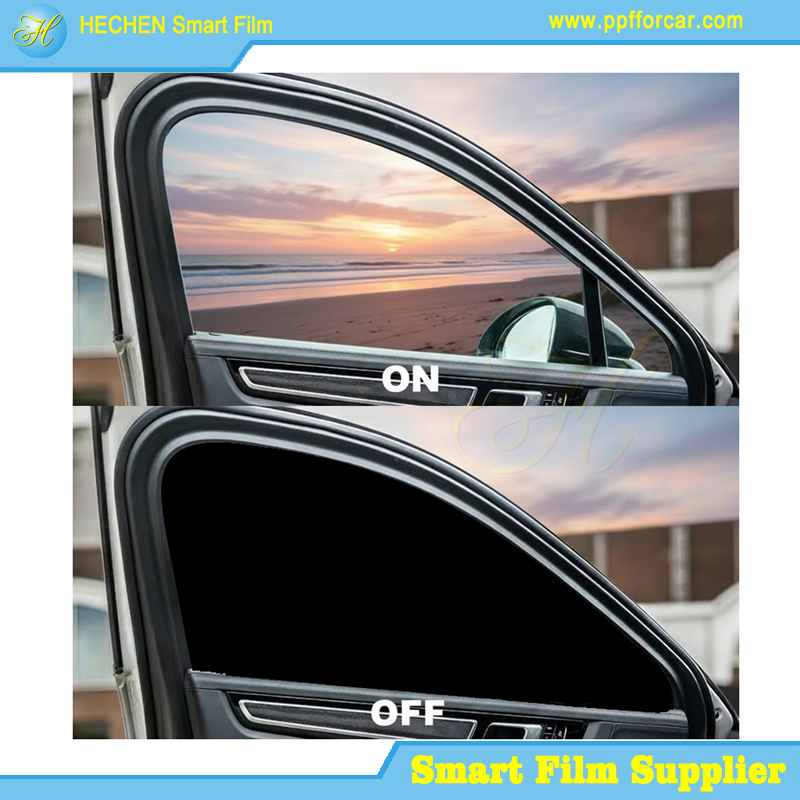
Car tint window film electric refers to thin, laminate-able optical devices that alter their light transmission properties in response to an applied electrical voltage. These films are typically sandwiched between layers of automotive safety glass or applied as aftermarket retrofits to existing windows, enabling dynamic control over visible light transmittance, solar heat gain, and privacy levels.
The fundamental value proposition of car tint window film electric lies in its ability to combine multiple functions—privacy control, thermal management, UV protection, and aesthetic customization—into a single, electronically controllable surface. This eliminates the need for mechanical sunshades, roller blinds, or permanently dark glass, offering a cleaner, more integrated solution for modern vehicle design.
Section 2: Core Technologies Powering Electric Tint Film
Two primary technological approaches dominate the car tint window film electric landscape, each with distinct operational principles and performance characteristics.
2.1 Polymer Dispersed Liquid Crystal (PDLC) Technology
PDLC represents the most widely adopted architecture for car tint window film electric applications. The film consists of microscopic liquid crystal droplets dispersed within a polymer matrix, sandwiched between transparent conductive layers coated onto flexible PET substrates.
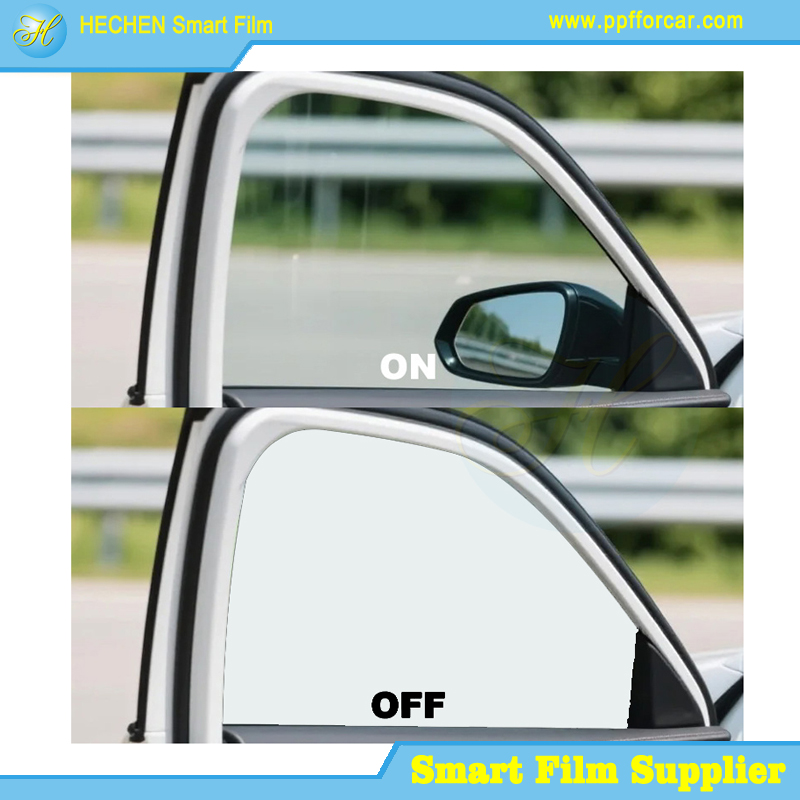
Working Principle: PDLC technology combines liquid crystals with a polymer matrix through a phase separation process during manufacturing. The liquid crystal droplets—typically 0.5–5 micrometers in diameter—are uniformly dispersed within the polymer network. When no voltage is applied, the liquid crystal molecules within each droplet adopt random orientations. This randomness causes a refractive index mismatch between the liquid crystals and the surrounding polymer, scattering incident light and rendering the film translucent or "frosted." When an alternating current (AC) voltage is applied across the conductive layers, an electric field aligns the liquid crystal molecules uniformly. Their refractive index now matches that of the polymer, allowing light to pass through with minimal scattering and rendering the film transparent.
PDLC-based car tint window film electric typically consumes approximately 4.5 watts per square meter and operates within a temperature range of -40°C to 75°C, making it suitable for diverse automotive environments. Input voltage ranges from 12-24V DC, with working voltage of 40-60V AC.
2.2 Electrochromic (EC) Technology
Electrochromic films operate on a fundamentally different principle. Unlike PDLC, which switches between transparent and translucent states, electrochromic materials undergo reversible color and opacity changes through electrochemical reactions. When an electrical stimulus is applied, ions migrate between layers within the film, causing the material to darken or lighten gradually.
Key Differentiator: While PDLC provides instantaneous binary switching with a distinctive frosted appearance, electrochromic technology offers smooth, continuous dimming from near-clear to deeply tinted states, making it particularly suitable for applications where aesthetic integration and variable light control are paramount.
Recent industry developments demonstrate the scalability of electrochromic technology. Mativ and Miru have successfully fabricated one of the world's largest electrochromic sunroof devices—a compound-curved prototype measuring 1.5 meters by 1.6 meters—demonstrating manufacturability for next-generation vehicle design.
2.3 Suspended Particle Device (SPD) Technology
SPD represents a third technological approach, utilizing microscopic light-absorbing particles suspended in a fluid between conductive layers. When voltage is applied, these particles align, allowing light to pass through; when power is removed, they return to random orientation, blocking light. This technology offers variable tint control with fast switching speeds and excellent solar heat rejection.
Section 3: Technical Specifications and Performance Parameters
Engineers specifying car tint window film electric systems must evaluate several critical parameters based on real-world product data:
Power Consumption: PDLC-based films typically consume approximately 4.5 watts per square meter to maintain transparency, with negligible power required in the opaque state. Input voltage ranges from 12-24V DC, with working voltage of 40-60V AC.
Transparency Performance: Transparency when powered typically reaches 60% for standard formulations, with premium products achieving 83-87% visible light transmittance. In the opaque state, haze exceeds 97%, creating effective privacy.
UV Protection: High-quality car tint window film electric blocks up to 99.9% of harmful UV rays, protecting both occupants and interior materials from photodegradation regardless of the tint state.
Solar Heat Rejection: Advanced formulations can achieve total solar energy rejection of up to 95.6% in the opaque state, significantly reducing cabin heat load. Even in partially dimmed states, these films provide substantial thermal benefits, with solar heat gain coefficients ranging from 0.04 to 0.43 depending on tint level.
Environmental Durability: Automotive-grade films must withstand operating temperatures from -40°C to +85°C, intense UV exposure, humidity, and mechanical vibration without performance degradation. Premium products offer warranties extending to 5-10 years.
Switching Speed: PDLC films transition in milliseconds—functionally instantaneous for human perception. Electrochromic films transition more gradually, typically over 30-120 seconds, offering smoother visual transitions.
Film Thickness: Typical film thickness ranges from 0.12mm to 0.5mm, allowing seamless integration into laminated glass assemblies or direct application to existing windows. Ultra-thin formulations measuring only 75 micrometers are available for specialized applications.
Section 4: Automotive Applications and Functional Benefits
4.1 Privacy Control
One of the most compelling advantages of car tint window film electric is its ability to provide instant, on-demand privacy. With the push of a button or via smartphone integration, windows transition seamlessly from fully transparent to darkly opaque.
This dynamic feature is ideal for luxury sedans and executive vehicles where passenger confidentiality is paramount, as well as ride-sharing or chauffeur services where privacy enhances customer experience. Systems can be programmed to activate automatically when doors are locked or the vehicle is parked, eliminating the need for physical curtains or permanent dark tints that may violate local regulations.
4.2 Thermal Management and Energy Efficiency
Car tint window film electric delivers quantifiable improvements in vehicle thermal management. By dynamically controlling solar heat gain, these films reduce cabin temperatures and minimize air conditioning load. Advanced formulations can reduce cabin heat by up to 95.6% when fully activated.
This thermal benefit translates to tangible energy savings—particularly significant for electric vehicles where energy efficiency directly impacts driving range. Miru's eWindow technology, combined with Argotec's optically clear polymer films, can extend EV range by up to 10% through advanced solar heat control.
By blocking 60-70% of solar heat gain, these films reduce the greenhouse effect caused by sunlight entering through windows. This natural cooling effect lowers the cabin temperature, especially when parked under direct sunlight, reducing interior temperatures by up to 20°F (11°C).
4.3 UV Radiation Protection
Car tint window film electric blocks up to 99.9% of harmful ultraviolet rays, protecting both passengers and the vehicle's interior. Prolonged UV exposure can cause skin damage and increase the risk of skin cancer, making this protection crucial for long-term health. This protection remains consistent regardless of tint level, ensuring skin safety and interior preservation even when the film is in its clear state.
In addition, UV rays degrade dashboards, upholstery, and trim over time. By filtering these rays, electric tints help preserve the car's interior, maintaining resale value and reducing the need for costly repairs or replacements.
4.4 Glare Reduction and Visual Comfort
Bright sunlight, especially during sunrise and sunset, can create dangerous glare on windshields and side windows. Car tint window film electric allows drivers to adjust tint levels in real time to minimize visual discomfort and improve road visibility.
Sensor-integrated systems can provide automatic glare protection by incorporating light sensors that detect approaching headlight intensity or high-angle solar incidence. These systems adjust film opacity in real-time, enhancing driving safety without requiring manual intervention. This reduces eye strain and fatigue on long drives, particularly benefiting older drivers or those sensitive to light.
4.5 Panoramic Sunroofs and Fixed Glass Roofs
The most established application for car tint window film electric involves panoramic sunroofs and fixed glass roofs. Modern automotive design increasingly incorporates expansive glass surfaces that enhance cabin spaciousness but introduce challenges in solar heat management and privacy.
PDLC-enabled sunroofs eliminate mechanical sunshades entirely, reducing weight, headroom intrusion, and mechanism complexity. Occupants can instantly transition from open-sky brightness to cool shade at the touch of a button. Products like the Kalt Win ACTIV Smart Tint offer pre-cut solutions for popular vehicles like Tesla Model 3 and Model Y, with up to seven levels of transparency adjustment.
4.6 Enhanced Security
By instantly darkening windows, car tint window film electric deters potential thieves by obscuring the view into the vehicle. This feature is especially useful when parked in public areas or overnight, discouraging break-ins by hiding valuables like bags, electronics, or navigation systems.
Systems can be linked to the car's alarm or security system to activate tinting upon lock or motion detection, providing peace of mind for fleet operators and rental car companies. A darkened interior signals reduced visibility, making the vehicle a less attractive target.
Section 5: Industry Developments and Market Landscape
5.1 Recent Commercial Milestones
The car tint window film electric industry has achieved significant commercial momentum. In May 2025, Mativ secured its first purchase order of materials used in Miru's dynamic electrochromic window technology from a major glass manufacturer, marking a major step forward in preparing the supply chain for large-scale production.
This agreement secures a significant volume of Argotec specialty thermoplastic polyurethane (TPU) interlayer film, a critical component in Miru's eWindow stack. The joint technology delivers optical clarity, durability, and manufacturability for next-generation eWindow systems.
5.2 Strategic Partnerships
In January 2026, Mativ announced an equity investment into Miru Smart Technologies to deepen their strategic partnership and support Miru in achieving commercial-scale production. Key elements of this enhanced partnership include aligned growth plans synchronizing Miru's goal of deploying 10 million square feet of eWindows by 2028 with Mativ's global extrusion capacity, optimization of operational systems for commercial-scale manufacturing, and integration of Argotec's high-performance TPU films into Miru's patented manufacturing process.
5.3 Market Growth Projections
The global market for car tint window film electric demonstrates robust growth, driven by increasing adoption in premium vehicles and electric cars. The technology is particularly gaining traction in electric vehicles where energy efficiency is paramount, with adoption rates in premium EVs expected to reach significant levels by 2025.
Asia-Pacific dominates global demand, accounting for over 40% of consumption, led by thriving automotive manufacturing sectors in China, Japan, and South Korea. North America follows, driven by stringent vehicle safety regulations and high adoption rates in luxury vehicles.
Section 6: Technical Challenges and Engineering Solutions
6.1 Voltage Compatibility and Power Conversion
Car tint window film electric systems requiring AC drive voltages face integration challenges with vehicle DC electrical systems. Modern controllers incorporate high-frequency resonant inverters minimizing size and electromagnetic interference, soft-start circuitry preventing inrush current surges, and output voltage regulation maintaining consistent performance despite input voltage variations.
6.2 Temperature Extremes and Environmental Durability
Automotive environments subject films to extreme temperature ranges from -40°C to +85°C. At low temperatures, liquid crystal viscosity increases, potentially slowing switching response. Premium automotive-grade films incorporate low-viscosity liquid crystal mixtures and modified polymer networks to maintain acceptable performance across the full operational range.
UV-stabilized polymers, nanoparticle-doped barrier coatings, and inherently photostable formulations prevent yellowing and delamination over vehicle lifetimes.
6.3 Optical Quality Expectations
Vehicle manufacturers demand near-perfect clarity in transparent states. Residual haze, visible electrode patterns, or non-uniform switching are unacceptable for premium applications. Premium PDLC films achieve haze levels below 5% in the transparent state, with continuous improvements in roll-to-roll coating precision and lamination techniques progressively reducing these artifacts.
6.4 Cost Barriers
Car tint window film electric remains significantly more expensive than conventional glass solutions, with current production costs substantially higher than conventional automotive glass. This restricts current applications primarily to premium vehicle segments, though economies of scale from increasing adoption are gradually closing the gap.
6.5 Regulatory Compliance
In most jurisdictions, front side windows and windshields must maintain minimum light transmission—typically 70% VLT under regulations like UN/ECE R43. Most electric tint films meet this requirement in their clear state, but opaque or heavily tinted states are non-compliant for driving. Robust interlocks preventing opacity activation when vehicles are in motion are essential for road-legal installations.
Before installing any car tint window film electric, checking local vehicle regulations is essential—many regions restrict the use of switchable or dark tints on front windows. Professional installation ensures proper wiring, sealing, and compliance with safety standards.
Section 7: Future Development Trajectories
7.1 Integration with Autonomous Vehicle Architectures
The development of connected and autonomous vehicle ecosystems presents substantial opportunities for car tint window film electric integration. Future autonomous vehicle concepts increasingly incorporate smart glazing as part of dynamic interior reconfiguration systems, allowing passengers to create private compartments or workspaces on demand.
Prototypes from leading automakers suggest that next-generation autonomous vehicles may feature extensive smart film applications throughout the cabin, transforming windows into multifunctional surfaces that switch between privacy mode and interactive displays.
7.2 Low-Voltage and Bistable Technologies
Recent research demonstrates significant progress toward reduced operating voltages. Advanced formulations are moving toward direct 12V DC operation, simplifying installation and reducing power conversion requirements. Emerging ferroelectric and cholesteric liquid crystal modes exhibit bistability—maintaining optical states indefinitely without power, consuming energy only during transitions.
7.3 Integrated Sensor Systems and Automation
Future car tint window film electric systems will incorporate increasingly sophisticated sensor integration. Photosensors detecting sun position, occupancy sensors identifying sleeping passengers, and integration with vehicle navigation systems will enable fully autonomous, context-aware tinting that anticipates user needs rather than merely responding to commands.
Integration with vehicle infotainment systems, voice assistants (like Alexa or Siri), or mobile apps enables intuitive control. Some systems already support automatic tinting based on GPS location, time of day, or ambient light sensors, providing a hands-free, adaptive experience tailored to driving conditions.
7.4 Energy-Harvesting Capabilities
Experimental research explores integrating photovoltaic capabilities into smart film structures, potentially transforming vehicle windows into supplemental power sources. Such innovations would be particularly valuable for electric vehicles seeking to maximize range through ancillary energy harvesting.
7.5 Enhanced Durability Through Advanced Materials
Ongoing research explores nanoparticle-doped systems that simultaneously improve electro-optical performance and enable additional functionalities. Self-healing coatings and advanced encapsulation techniques address durability concerns, extending film lifetime in demanding automotive environments.
Section 8: Comparative Analysis with Alternative Technologies
8.1 Switchable Smart Film (PDLC) vs. Smart Tint Film (Electrochromic)
PDLC technology offers instantaneous on/off switching between clear and opaque states, making it ideal for applications where immediate privacy is paramount. However, it consumes continuous power when transparent and may appear slightly hazy in clear mode.
Electrochromic technology provides variable tint levels for customizable shading, consumes power only during transitions, and offers a smooth, glass-like finish with minimal distortion. However, it has slower transition speeds and higher initial cost.
8.2 Electric Films vs. Traditional Static Tint
Traditional static window tint offers a fixed shade with no adjustability, lower initial cost, and simple installation, but provides no user control and may violate regulations if too dark. Car tint window film electric offers instant adjustability, compliance with legal requirements through switchable states, and integrated UV protection, but requires power and involves higher initial investment.
Conclusion
Car tint window film electric represents a convergence of materials science, electro-optics, and automotive engineering that transforms ordinary glass into an intelligent, responsive element of the vehicle environment. From the fundamental physics of liquid crystal alignment to the practical considerations of automotive integration, this technology enables unprecedented user control over privacy, solar heat management, and interior ambiance.
The market trajectory is clear: growing adoption in premium vehicles, strategic partnerships preparing supply chains for mass production, and continuous technological improvements addressing cost and performance barriers. Recent breakthroughs in large-format electrochromic sunroofs, together with landmark commercial orders from major glass manufacturers, accelerate the path toward mainstream adoption.
With its ability to block 99.9% of UV rays, reject up to 95.6% of solar heat, and extend EV range by up to 10%, car tint window film electric delivers tangible, quantifiable benefits that address critical industry challenges. As autonomous vehicle architectures mature and consumer expectations for personalized, adaptive interiors intensify, this technology will transition from a luxury differentiator to essential automotive equipment.
The window is no longer merely a window—it is a surface that responds, adapts, and protects. Car tint window film electric is the foundational technology making this transformation possible, fundamentally redefining the relationship between vehicle occupants and their surrounding environment.
For more about what is electric tint film for car window? Everything you need to know, you can pay a visit to Hechen PDLC Smart Film Manufacturers for more info.


评论
发表评论