PDLC Folie Auto: Technical Guide to Polymer Dispersed Liquid Crystal Films for Auto Applications
The automotive industry is undergoing a profound transformation in how vehicles manage light, privacy, and thermal comfort. At the forefront of this evolution lies PDLC Folie Auto technology—a sophisticated electro-optical solution that enables drivers and passengers to control window transparency instantly at the touch of a button. This comprehensive technical article explores the scientific principles, performance parameters, automotive applications, market dynamics, and future trajectory of Polymer Dispersed Liquid Crystal films specifically engineered for automotive use.
Section 1: Understanding PDLC Folie Auto Technology
PDLC Folie Auto refers to Polymer Dispersed Liquid Crystal films designed for automotive glazing applications. These advanced optical materials transition between transparent and opaque states when an electrical current is applied, offering dynamic control over light transmission, privacy levels, and solar heat gain.
The fundamental working principle of PDLC Folie Auto relies on the dielectric anisotropy of liquid crystal molecules. The film consists of microscopic liquid crystal droplets—typically 0.5–5 micrometers in diameter—uniformly dispersed within a polymer matrix, sandwiched between transparent conductive layers coated onto flexible PET substrates.
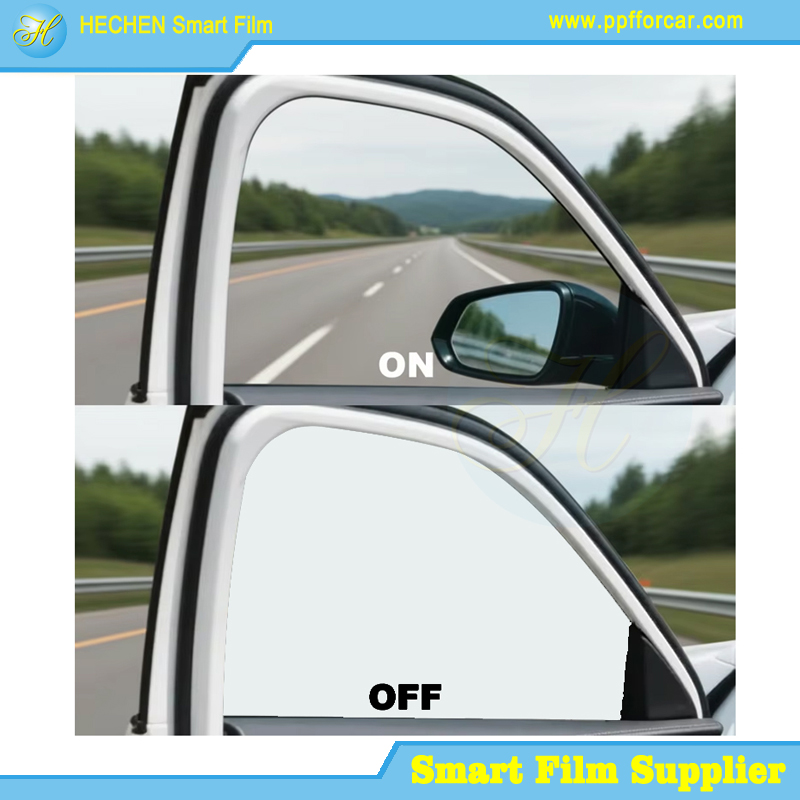
When no voltage is applied, the liquid crystal molecules within each droplet adopt random orientations, creating a refractive index mismatch between the liquid crystals and the surrounding polymer. This mismatch causes incident light to scatter multiple times, rendering the film translucent or "frosted." When an alternating current voltage is applied across the conductive layers, an electric field aligns the liquid crystal molecules uniformly. Their refractive index now matches that of the polymer, allowing light to pass through with minimal scattering and rendering the film transparent.
This electro-optical switching occurs in milliseconds, providing instantaneous control over window transparency that is functionally immediate for human perception.
Section 2: Technical Specifications and Performance Parameters
PDLC Folie Auto must meet stringent automotive-grade requirements to withstand the extreme conditions of vehicle environments. Key performance parameters include:
Optical Performance: Premium automotive PDLC films achieve visible light transmittance of 83-90% in the transparent state when powered on. In the opaque state, haze exceeds 98%, creating effective privacy with minimal light transmission. High-quality films maintain haze levels below 5% in the transparent state, ensuring optical clarity suitable for driving applications. Advanced formulations achieve light switching times of ≤0.2 seconds, enabling rapid transitions between states.
Electrical Characteristics: Typical PDLC Folie Auto consumes approximately 4.5 watts per square meter to maintain the transparent state, with negligible power required in the opaque state. Input voltage ranges from 12-24V DC, compatible with standard automotive electrical architectures, with working voltage of 40-60V AC supplied by integrated DC-AC inverters. Some newer formulations support direct 12V DC operation, simplifying installation requirements.
Environmental Durability: Automotive-grade films must withstand operating temperatures from -40°C to +85°C, encompassing the extreme conditions experienced in vehicle interiors. Premium formulations are engineered for durability under direct sunlight exposure, capable of operating reliably at temperatures up to 85°C and beyond. Storage temperature specifications typically range from -20°C to +70°C.
UV and Heat Rejection: High-quality PDLC Folie Auto blocks up to 99.9% of harmful ultraviolet rays, protecting both occupants and interior materials from photodegradation. Advanced formulations achieve infrared blocking rates of ≥90% and heat insulation rates of ≥90%, significantly reducing cabin heat load. This thermal management capability is particularly valuable for electric vehicles where reduced air conditioning load directly extends driving range.
Lifespan and Durability: Premium PDLC Folie Auto products offer operational lifetimes of 5-10 years with warranties to match. Switching cycles are rated for over 200 million transitions in quality formulations, ensuring long-term reliability. Film thickness typically ranges from 0.12mm to 0.5mm, allowing seamless integration into laminated glass assemblies or direct application to existing windows.
Section 3: Types of PDLC Folie Auto
Manufacturers offer multiple grades of PDLC Folie Auto to address different application requirements and environmental conditions:
Standard PDLC Film: Offers high optical clarity in its transparent state, with light transmission reaching up to 85%. When activated, it achieves near-total opacity due to effective light scattering within the polymer matrix. Operating temperature range is typically 25°C to 60°C, suitable for moderate climate applications and interior installations.
High-Temperature PDLC Film: Engineered specifically for automotive interiors exposed to direct sunlight, capable of operating reliably at temperatures up to 85°C and beyond. This variant maintains stable electro-optical properties under thermal stress and is ideal for sunroofs, windshields, and side windows in vehicles operating in hot climates.
Self-Adhesive PDLC Film: Features a pressure-sensitive adhesive backing that bonds directly to existing glass surfaces, offering a cost-effective solution for retrofitting conventional vehicles without replacing the glass. Installation is simplified, though professional application is recommended to avoid air bubbles and ensure proper electrical connections.
Non-Adhesive PDLC Film: Designed to be laminated between two layers of automotive safety glass, providing superior optical clarity and long-term durability. This is the preferred solution for OEM integrations where the film becomes an integral part of the glass assembly.
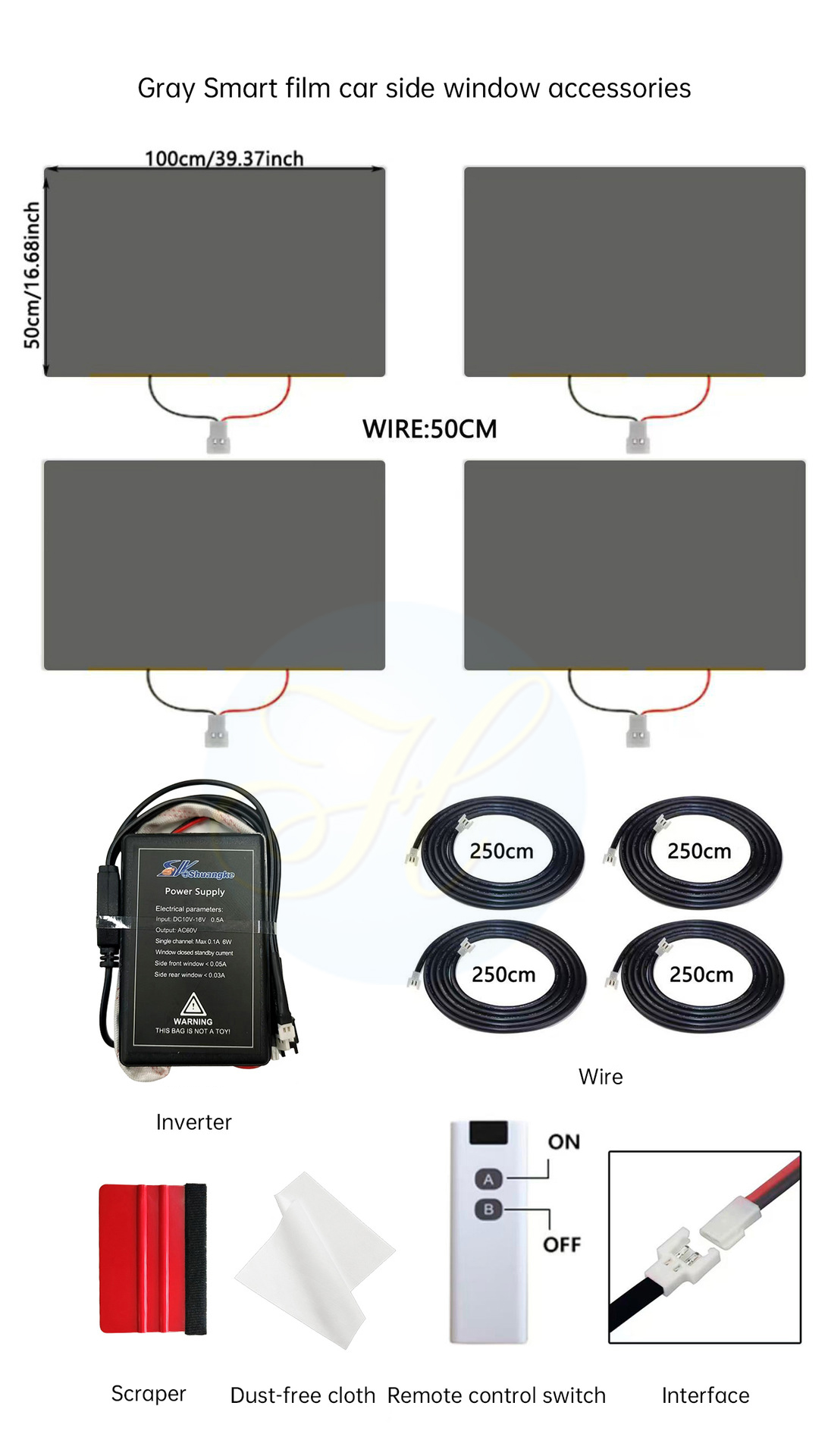
Colorful PDLC Film: Available in aesthetic options including frosted white, blue, green, gray, and other colors, allowing vehicle owners to match interior themes or achieve specific styling effects while maintaining full smart glass functionality.
Section 4: Automotive Applications of PDLC Folie Auto
PDLC Folie Auto technology finds diverse applications across the automotive sector, enhancing comfort, safety, and user experience:
Panoramic Sunroofs and Fixed Glass Roofs: The most established application involves sunroofs and fixed glass roofs. Modern automotive design increasingly incorporates expansive glass surfaces that enhance cabin spaciousness but introduce challenges in solar heat management and privacy. PDLC-enabled sunroofs eliminate mechanical sunshades entirely, reducing weight, headroom intrusion, and mechanism complexity. Occupants can instantly transition from open-sky brightness to cool shade at the touch of a button, with pre-cut solutions now available for popular vehicles like the Tesla Model Y.
Side Windows and Privacy Glass: Luxury vehicles increasingly deploy PDLC Folie Auto on rear side windows, offering on-demand privacy for passengers. Unlike traditional privacy glass that maintains constant darkness, PDLC-equipped windows remain transparent for optimal visibility during travel, switching to opaque only when privacy is desired. This functionality is particularly valuable for executive sedans, limousines, and ride-sharing vehicles where passenger confidentiality is paramount.
Automatic Glare Reduction Systems: Recent research has demonstrated the potential for sensor-integrated PDLC systems to provide automatic glare protection. By incorporating Light Dependent Resistor (LDR) sensors that detect approaching headlight intensity, these systems can adjust film opacity in real-time. Experimental results show that at a distance of 1 meter from a light source, PDLC film can block up to 99.85% of incoming light, reducing 12,080 lux to only 17 lux. The system begins reacting at 6 meters distance, becoming fully transparent at 8-9 meters where glare risk diminishes, offering a promising solution for minimizing night-driving hazards.
Privacy Partitions: Commercial vehicles, VIP transport vehicles, and emerging autonomous vehicle concepts utilize PDLC Folie Auto in glass partitions separating driver and passenger compartments. Instant switching between transparent for communication and opaque for privacy replaces mechanical curtains or sliding panels, offering superior aesthetic integration and reliability.
Heads-Up Displays and Interactive Surfaces: Emerging applications integrate PDLC technology with transparent display systems. Future autonomous vehicle concepts may feature extensive smart film throughout the cabin, creating surfaces that can switch between privacy mode and interactive touch displays. Heads-up displays can be dynamically controlled to reduce glare or improve contrast under varying lighting conditions, minimizing driver distraction.
Electrochromic Sun Visors: PDLC film can be used to create sun visors that switch from clear to opaque electronically, either at the press of a button or automatically via sensors detecting light intensity through the window.
Anti-Glare Mirrors: Rearview mirrors incorporating PDLC technology can switch from clear to anti-glare mode when driving at night, improving safety by reducing headlight glare from following vehicles.
Section 5: Market Dynamics and Industry Landscape
The global market for PDLC Folie Auto demonstrates robust growth, driven by increasing adoption in premium vehicles and electric cars. The PDLC smart film for automotive market was valued at approximately USD 560.3 million in 2024 and is projected to reach USD 1.21 billion by 2032, exhibiting a compound annual growth rate of 9.7% during the forecast period.
Regional Analysis: Asia-Pacific dominates the global market, accounting for over 40% of demand. The region's leadership stems from thriving automotive manufacturing sectors in China, Japan, and South Korea, coupled with rapid adoption of smart glass technologies in premium vehicle segments. China alone contributes nearly 60% of regional PDLC film consumption, driven by government policies promoting smart transportation solutions and growing consumer preference for luxury features.
North America maintains a considerable market position due to stringent vehicle safety regulations and high adoption rates in luxury vehicles. Europe maintains significant market presence through premium automotive manufacturers integrating PDLC technology as standard equipment in flagship models.
Key Industry Players: The competitive landscape features established specialists and emerging innovators. Leading manufacturers include DMDisplay (China), Gauzy (Israel), Filmbase (South Korea), Rayno (U.S.), Magic Film (Germany), Smart Films International, IRISFILM Corp., and Polytronix Inc. Chinese manufacturers including Hunan Haozhi Technology and Shanghai HIUV New Material are gaining traction through cost-competitive manufacturing and government-supported smart material initiatives.
Major glass manufacturers entering the space include Saint-Gobain, AGC, NSG Group, Fuyao Glass, and Gentex, recognizing the strategic importance of integrated smart glazing solutions.
Section 6: Technical Challenges and Engineering Solutions
PDLC Folie Auto faces several technical challenges that manufacturers are actively addressing:
Voltage Compatibility and Power Conversion: PDLC films require AC drive voltages of 40-60V, while automotive electrical systems provide 12V or 48V DC. Modern controllers incorporate high-frequency resonant inverters minimizing size and electromagnetic interference, soft-start circuitry preventing inrush current surges, and output voltage regulation maintaining consistent performance despite input voltage variations.
Temperature Extremes and Environmental Durability: Automotive environments subject films to temperatures ranging from -40°C to +85°C. Premium automotive-grade films incorporate low-viscosity liquid crystal mixtures and modified polymer networks to maintain acceptable performance across the full operational range. UV-stabilized polymers, nanoparticle-doped barrier coatings, and inherently photostable formulations prevent yellowing and delamination over vehicle lifetimes.
Optical Quality Expectations: Vehicle manufacturers demand near-perfect clarity in transparent states. Residual haze, visible electrode patterns, or non-uniform switching are unacceptable for premium applications. Continuous improvements in roll-to-roll coating precision and lamination techniques progressively reduce these artifacts, with premium films achieving haze levels below 5% in the transparent state.
Cost Barriers: PDLC Folie Auto remains significantly more expensive than conventional glass solutions. Current production techniques require specialized cleanroom environments and precision liquid crystal alignment, resulting in costs substantially higher than conventional automotive glass. This restricts current applications primarily to premium vehicle segments, though economies of scale from increasing adoption are gradually closing the gap.
Regulatory Compliance: Front side windows and windshields must maintain minimum light transmission—typically 70% VLT under regulations like UN/ECE R43. PDLC's transparent state meets this requirement, but the opaque state is non-compliant for driving. Robust interlocks preventing opacity activation when vehicles are in motion are essential for road-legal installations.
Section 7: Future Development Trajectories
The evolution of PDLC Folie Auto continues with several promising developments:
Integration with Autonomous Vehicle Architectures: Future autonomous vehicle concepts may feature up to 15 square meters of PDLC film per cabin, potentially creating a $1.2 billion addressable market by 2032. These applications extend beyond privacy to include dynamic interior reconfiguration and interactive surfaces.
Bistable and Low-Voltage Technologies: Emerging ferroelectric and cholesteric liquid crystal modes exhibit bistability—maintaining optical states indefinitely without power, consuming energy only during transitions. This would eliminate steady-state power consumption and simplify vehicle electrical integration.
Integrated Sensor Systems: Future systems will incorporate sophisticated sensor integration, with photosensors detecting sun position, occupancy sensors identifying sleeping passengers, and integration with vehicle navigation systems enabling fully autonomous, context-aware tinting that anticipates user needs.
Energy-Harvesting Capabilities: Experimental research explores integrating photovoltaic capabilities into PDLC film structures, with some models achieving 8-10% solar energy conversion efficiency while maintaining optical clarity. Such innovations could transform vehicle windows into supplemental power sources for electric vehicles.
Enhanced Durability Through Advanced Materials: Ongoing research explores nanoparticle-doped PDLC systems that simultaneously improve electro-optical performance and enable additional functionalities. Self-healing nano-coatings address durability concerns previously limiting applications in high-wear environments.
Conclusion
PDLC Folie Auto represents a convergence of materials science, electro-optics, and automotive engineering that transforms ordinary glass into an intelligent, responsive element of the vehicle environment. From the fundamental physics of liquid crystal alignment to the practical considerations of automotive integration, this technology enables unprecedented user control over privacy, solar heat management, and interior ambiance.
With its ability to block 99.9% of UV rays, reject up to 90% of solar heat, and provide instant on-demand privacy, PDLC Folie Auto delivers tangible, quantifiable benefits that address critical industry challenges. The market trajectory is clear: growing at nearly 10% annually, driven by premium vehicle adoption and electric vehicle requirements for energy-efficient climate control.
As autonomous vehicle architectures mature and consumer expectations for personalized, adaptive interiors intensify, PDLC Folie Auto will transition from a luxury differentiator to essential automotive equipment. The window is no longer merely a window—it is a surface that responds, adapts, and protects, fundamentally redefining the relationship between vehicle occupants and their surrounding environment.
For more about PDLC Folie Auto: Technical Guide to Polymer Dispersed Liquid Crystal Films for Auto Applications. Everything you need to know, you can pay a visit to Hechen PDLC Smart Film Manufacturers for more info.


评论
发表评论