Anti-Glare and Smart Dimming: Best PDLC Film for Night Driving
In the modern driving experience, few phenomena are as universally detested yet physically unavoidable as headlight glare. As automotive lighting technology has evolved from the warm, dim glow of halogen bulbs to the intensely bright and blue-white output of High-Intensity Discharge (HID) and LED matrix headlights, the problem of glare has intensified. While these advancements significantly improve the driver's visibility, they often do so at the expense of oncoming traffic. For aging eyes, which are more susceptible to light scatter, this glare can transform a routine night drive into a blinding and hazardous experience.
Traditional solutions have been limited to polarized sunglasses (which are ineffective against most LCD screens and become useless at night) or manually operated sun visors that fail to block low-angle light. However, a paradigm shift is occurring in automotive glazing, driven by the integration of Smart Glass technology. Specifically, Polymer Dispersed Liquid Crystal (PDLC) film is emerging as the definitive solution for dynamic glare control. This article provides a deep technical dive into how advanced PDLC films function, the specific engineering requirements for automotive applications, and why they represent the "best" technology for anti-glare and smart dimming during night driving.
Chapter 1: The Physics of Glare and the Need for Speed
To understand why PDLC is superior, we must first analyze the problem. Disability glare occurs when stray light enters the eye and scatters within the ocular media, creating a luminous veil over the retina. This reduces contrast sensitivity—the ability to distinguish objects from their background. At night, a momentary blast of 3000 lumens from an oncoming LED headlight can cause the pupils to constrict and the retina to take several seconds to recover. At 60 mph, a car travels 88 feet per second; a two-second recovery time equates to nearly 176 feet traveled while effectively blind.
The ideal solution must possess two critical characteristics:
High Dynamic Range (HDR): The ability to switch rapidly between a transparent state and a dimmed state.
Spatial Selectivity: The ability to dim specific sections of the window (e.g., just the lower half where headlights hit) rather than the entire field of view.
This is where PDLC technology enters the arena, offering a response time measured in milliseconds—fast enough to react to the blink of an oncoming high beam.
Chapter 2: Understanding PDLC Technology – The Technical Breakdown
Polymer Dispersed Liquid Crystal film is a smart material that can be switched between translucent and transparent states via the application of an AC voltage. It is a complex composite structure sandwiched between two transparent conductive layers, typically Indium Tin Oxide (ITO) coated on Polyethylene Terephthalate (PET) film.
2.1 The Microscopic Structure
At the heart of the film are microdroplets (typically 0.5 to 3 micrometers in diameter) of liquid crystal suspended in a solid polymer matrix. The liquid crystal molecules possess dielectric anisotropy—meaning their optical properties change based on their orientation relative to an electric field.
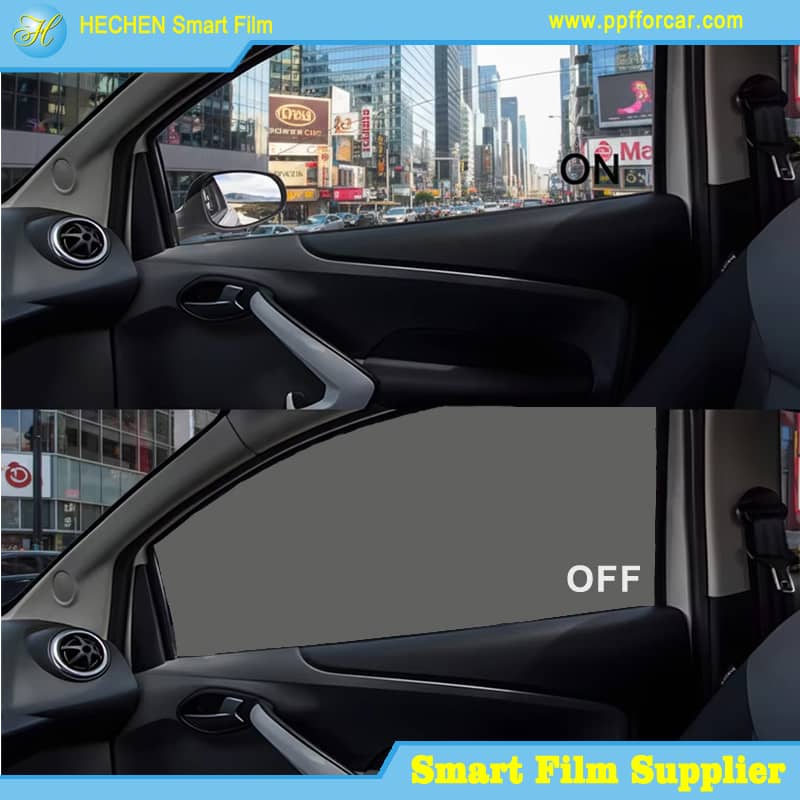
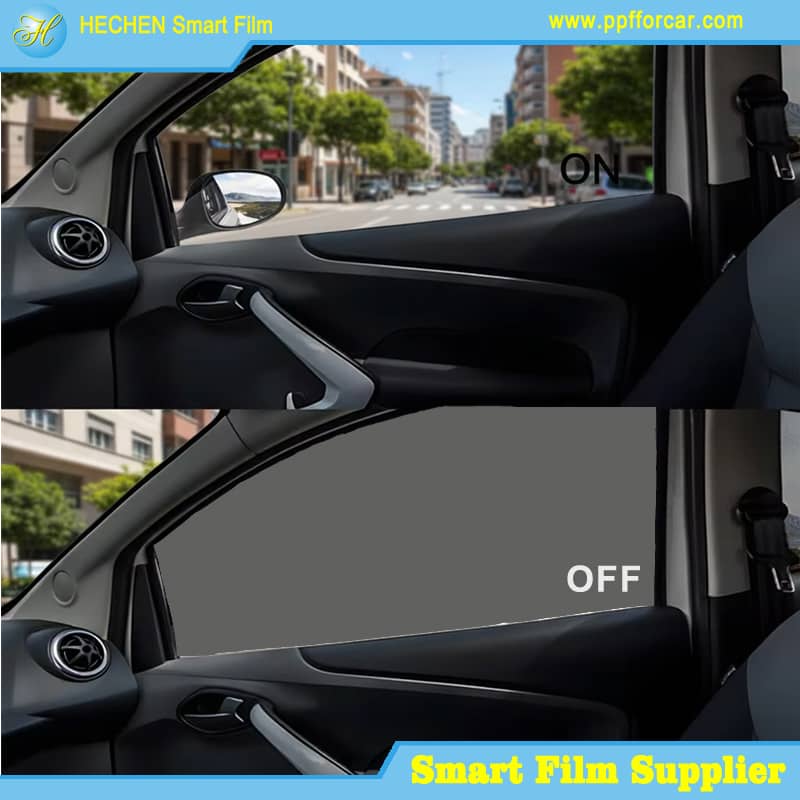
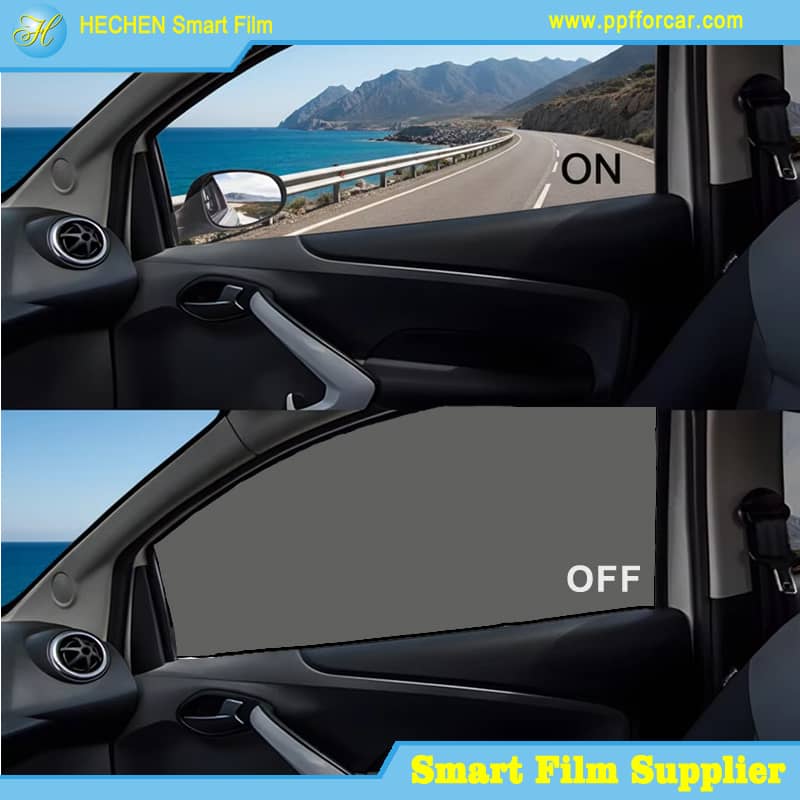
The OFF State (Opaque/Frosted): In the absence of an electric field, the liquid crystal molecules within each droplet arrange themselves in a random, disordered orientation. Because the refractive index of the randomly oriented liquid crystal (n₀) does not match the refractive index of the surrounding polymer (np), light passing through the film encounters numerous boundaries between droplets and polymer. This mismatch causes the light to scatter in all directions, resulting in a milky, translucent appearance. This scattering effect is the key to glare reduction; it diffuses the intense, directional light of an oncoming headlight into a soft, uniform glow.
The ON State (Clear): When an AC voltage (typically 30-110V RMS at 50/60Hz) is applied across the conductive layers, an electric field is generated. The liquid crystal molecules align themselves parallel to the direction of this field. In this aligned state, the extraordinary refractive index (ne) of the liquid crystal aligns with the refractive index of the polymer. With the indices matched, light passes through the film with minimal scattering, rendering the film transparent.
2.2 The Automotive Adaptation: From Privacy to Driving Aid
Standard architectural PDLC film is designed for office privacy; its switching speed and optical clarity are sufficient for a conference room but inadequate for a moving vehicle. The "best" film for night driving requires several specific technical enhancements.
Chapter 3: Key Technical Specifications for Night Driving PDLC
Selecting the best PDLC film for automotive glazing—specifically for anti-glare—requires scrutiny of five critical performance metrics.
3.1 Haze and Transparency
In the automotive sector, "clear" must be exceptionally clear. Standard PDLC can have a slight haze (2-5%) even in its clear state. For a windshield or driver-side window, this is unacceptable as it can create halos around light sources. High-end automotive PDLC films utilize advanced liquid crystal mixtures and refined polymer curing processes to achieve a transparent state with less than 1% haze. This ensures zero visual distortion when the film is off (clear).
3.2 Switching Speed and Frequency
To combat headlight glare, the film must transition from clear to dimmed almost instantaneously. The "best" films utilize low-viscosity liquid crystal mixtures to achieve rise times (clear to dim) of less than 10 milliseconds. The decay time (dim to clear) is slightly slower, governed by the elastic restoring forces of the polymer matrix, but still under 50ms. Furthermore, to prevent flicker perception and ensure comfort, these films are driven by high-frequency inverters (70-100Hz) to eliminate any visible oscillation in transparency.
3.3 Operating Temperature Range
A car interior can exceed 80°C (176°F) in summer and drop below -30°C (-22°F) in winter. Liquid crystals are, by nature, temperature-sensitive fluids. Standard PDLC can become sluggish in the cold or lose orientation in extreme heat. The best films utilize wide-temperature-range liquid crystal mixtures that maintain consistent switching speeds from -40°C to +90°C, ensuring the anti-glare function works whether you are driving in a blizzard or a desert heatwave.
3.4 UV and IR Rejection
Integrating the PDLC film into laminated glass (typically between two layers of PVB) allows for the incorporation of UV and Infrared inhibitors. The best systems are not just switchable dimming devices; they are functional glazing components that block >99% of UV radiation (preventing skin damage and interior fading) and reject significant IR radiation (keeping the car cooler, thus reducing the load on the air conditioning and the heat stress on the film itself).
3.5 Memory and Stability
Power stability is crucial. In the event of a power failure, the film defaults to its "off" (dimmed) state. However, the film must retain its memory. High-quality films use stable polymer networks that prevent the liquid crystal from "pooling" or separating over time, ensuring decades of reliable operation without optical degradation.
Chapter 4: The Architecture of the Smart Dimming System
The film itself is only one component of a functional smart dimming system. For night driving applications, the system architecture is what transforms a simple privacy film into an intelligent anti-glare shield.
4.1 Lamination and Safety
PDLC film is never used as a surface film on a windshield (which would be illegal and unsafe). Instead, it is encapsulated within the glass lamination process. The stack-up typically looks like this:
Outer Glass: Tempered or annealed outer pane.
Outer PVB Layer: Standard structural interlayer.
PDLC Film: The active smart layer.
Inner PVB Layer: A second structural layer that bonds the film to the inner glass.
Inner Glass: The inner pane facing the occupant.
This construction ensures that the glass remains a safety glazing material. In an accident, the PVB holds the glass together, preventing ejection, while the embedded PDLC film remains intact.
4.2 Zonal Control and Sensor Fusion
The "smart" aspect of smart dimming lies in its integration with the vehicle's electronics. The best systems utilize zonal dimming. By etching the conductive ITO layer into specific patterns (via laser or chemical etching), the windshield or side windows can be divided into multiple independent zones.
When coupled with a forward-facing camera (like those used for lane departure warning) and infrared eye-tracking sensors that monitor the driver's gaze, the system can perform "pixelated anti-glare."
The camera detects an oncoming vehicle's headlights.
The eye-tracker confirms the driver is looking forward.
The ECU calculates the precise location of the glare source on the windshield relative to the driver's eyes.
A voltage is applied to the specific zone(s) of the PDLC film corresponding to that location, turning them opaque just long enough for the vehicle to pass, while the rest of the windshield remains crystal clear.
This is functionally similar to Matrix LED headlights, but instead of dimming the light source, it dims the receptor (the glass), providing a "dynamic sun visor" that blocks glare without obscuring the road.
Chapter 5: Comparison with Alternative Technologies
To justify the "best" title, PDLC must be compared to its competitors:
Electrochromic (EC) Glass: Common in auto-dimming rearview mirrors and some sunroofs (e.g., the McLaren 720S). EC glass changes tint via an electrochemical reaction.
Pros: Excellent uniform dimming, holds state without power (memory).
Cons: Extremely slow switching speed (seconds to minutes). It cannot react to instantaneous headlight flashes. It dims the entire pane, not specific zones.
Suspended Particle Device (SPD): Uses rod-like particles suspended in a fluid that align under voltage.
Pros: Very fast switching and variable tint control.
Cons: Requires constant voltage to stay clear (fails to opaque), has a slightly bluish tint even when clear, and generally has higher power consumption than PDLC.
PDLC:
Pros: Millisecond switching, excellent for zoning (due to etching capabilities), low power consumption (only draws current during switching, not to maintain a state), and superior privacy/scattering effect for anti-glare.
Cons: The "off" state is translucent/milky, not a dark tint. (For night driving, this milky diffusion is actually superior to dark tint, as it eliminates the point source of light without completely blocking vision).
For the specific application of blocking directional glare at night, PDLC's scattering effect is functionally superior to the dark tint of EC or SPD, which merely reduces overall light transmission.
Chapter 6: Installation, Integration, and Future Outlook
6.1 OEM vs. Aftermarket
Currently, the best integration of PDLC for night driving comes from Original Equipment Manufacturers (OEMs) like Mercedes-Benz with their "Magic Glass" concepts or Continental with their "Smart Visor" technology. These systems are designed into the car from the ground up, with the laminated glass meeting stringent safety certifications.
Aftermarket installation is possible for rear passenger windows and sunroofs, but retrofitting a windshield is highly complex and often illegal due to the risk of compromising the structural integrity of the glass and interfering with ADAS (Advanced Driver Assistance Systems) cameras that look through the glass.
6.2 The Future: Film Innovation
The next generation of PDLC film aims to solve its last remaining limitation: the lack of a true black/dark state. Researchers are developing Dye-Doped PDLC. By incorporating dichroic dyes into the liquid crystal mixture, the film can absorb light in the off-state (appearing dark grey or black) and become clear in the on-state. This would combine the anti-glare scattering of PDLC with the tinting capabilities of SPD, offering the ultimate solution for both daytime heat rejection and nighttime anti-glare.
Conclusion
As automotive lighting becomes more powerful and the demographic of drivers ages, the need for dynamic glare protection is no longer a luxury—it is a safety necessity. PDLC film, specifically engineered for the rigorous demands of the automotive environment, offers the fastest response time, the potential for zonal dimming, and the unique light-scattering properties required to neutralize the blinding effect of modern headlights.
By understanding the technical nuances—from refractive index matching to high-temperature liquid crystal stability—engineers and consumers alike can identify the best PDLC solutions. These are systems that switch in milliseconds, remain optically clear when needed, and integrate seamlessly with vehicle sensor suites to create a cocoon of visibility, ensuring that the journey home at night is safer and more comfortable than ever before.
For more about anti-glare and smart dimming: best PDLC film for night driving, you can pay a visit to Hechen PDLC Smart Film Manufacturers for more info.


评论
发表评论