Is it difficult to install smart window tint for cars by myself?
TL;DR: This article provides a comprehensive technical evaluation of DIY installation for smart window tint for cars. While the process requires patience, attention to detail, and basic handyman skills, it is absolutely achievable for a motivated individual. The key challenges lie in glass preparation, bubble-free application, and proper electrical connection. With the right tools, a clean workspace, and step-by-step methodology, most car owners can successfully complete the installation within 3–5 hours. The conclusion firmly supports that self-installation is not only possible but also rewarding, offering significant cost savings and customization control.
1. Introduction
Smart window tint for cars has gained popularity as an innovative solution that combines privacy, heat rejection, and electronic control. Unlike traditional static tints, smart window tint for cars allows the user to switch between transparent and opaque states, typically via a small electrical current. A common question among car enthusiasts and practical owners is whether they can install such a system themselves. This article evaluates the technical difficulty, breaks down the installation process, identifies potential pitfalls, and concludes that a careful DIYer can indeed accomplish the task.
2. Understanding the Technology Behind Smart Window Tint
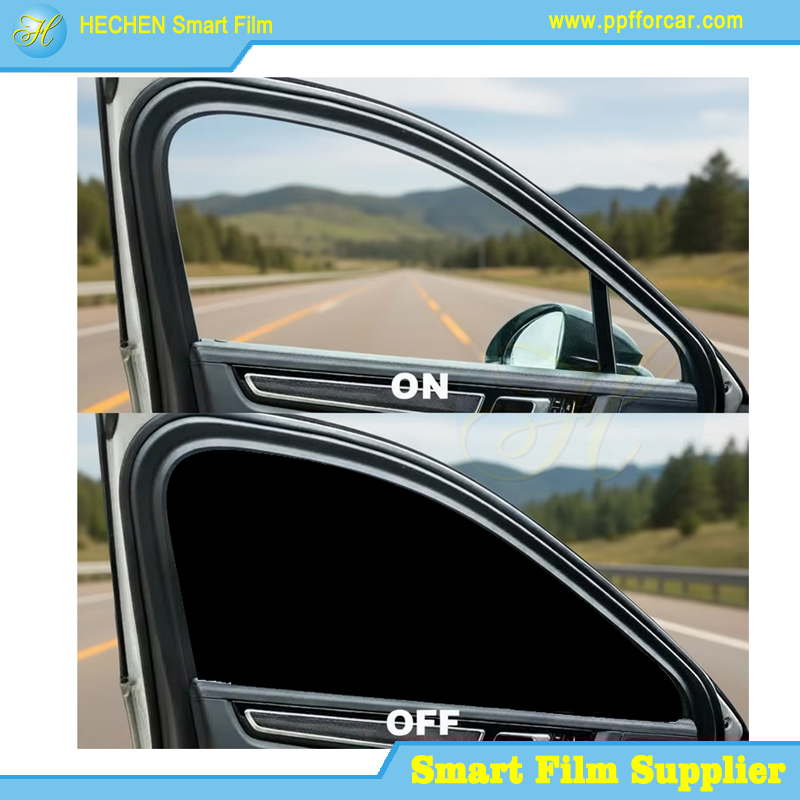
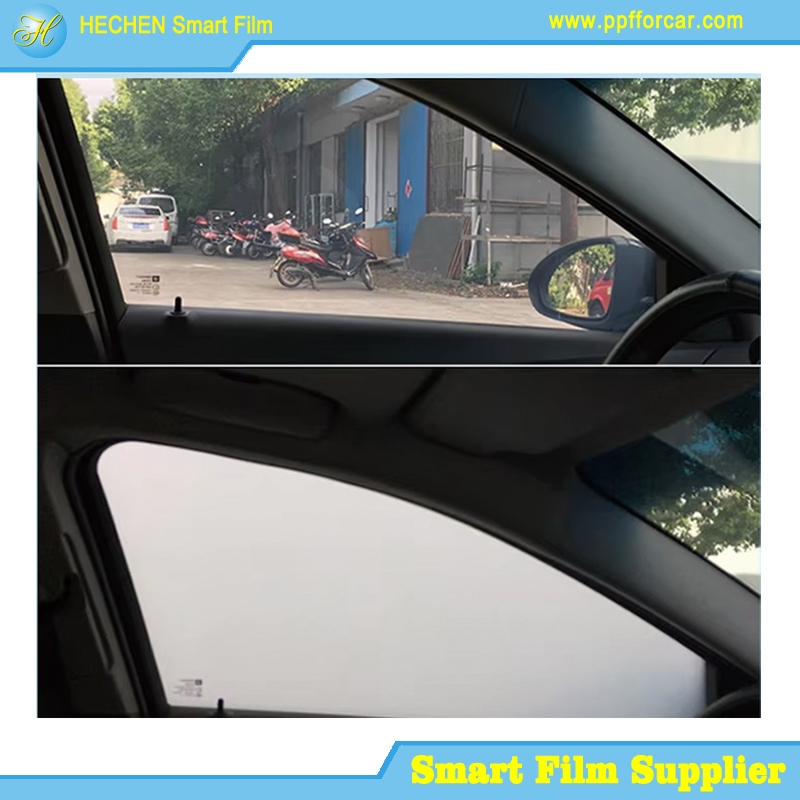
Before assessing installation difficulty, it is essential to understand what smart window tint for cars actually is. The most common technology used in automotive applications is PDLC (Polymer Dispersed Liquid Crystal). In its default state (power off), the liquid crystals are randomly oriented, scattering light and creating an opaque or frosted appearance. When an alternating current voltage is applied, the crystals align, allowing light to pass through and making the film transparent.
Other variants include electrochromic and thermochromic films, but PDLC dominates the DIY market due to its simpler control requirements (low voltage AC, typically 12V or 24V). The film consists of multiple layers: an adhesive layer for glass bonding, the PDLC layer, conductive transparent electrodes (usually ITO – Indium Tin Oxide), and a protective top coat. Electrical connections are made via bus bars along the edges.
Understanding this construction is crucial because installation is not just about sticking a film – it involves handling fragile conductive layers and making reliable electrical contacts.
3. Tools and Materials Required for DIY Installation
A successful DIY installation of smart window tint for cars demands a specific set of tools. Lacking any essential item can turn a manageable task into a frustrating failure. The required items include:
Smart window tint film pre-cut or roll (cut to exact window dimensions)
Control switch (momentary or latching, depending on the film type)
12V DC to AC inverter (most PDLC films require AC, not DC – critical)
Wire harness (thin, flexible copper wire, 22–26 AWG)
Soldering iron and solder (for attaching wires to bus bars)
Heat shrink tubing or electrical tape
Squeegee (preferably felt-edged to avoid scratching)
Spray bottle with soapy water (baby shampoo + distilled water)
Razor blade or precision knife
Lint-free microfiber cloths
Isopropyl alcohol (70% or higher)
Masking tape
Heat gun or hair dryer (low setting)
Multimeter (for continuity and voltage checks)
Having these tools ready before starting eliminates mid-project trips to the hardware store.
4. Step-by-Step Installation Process
4.1 Preparation – The Most Critical Phase
Cleaning the glass is paramount. Any dust, oil, or lint trapped under the film will cause visible defects and may even create electrical shorts. Use isopropyl alcohol and a lint-free cloth to clean both the interior and exterior of the window. Work in a dust-free environment – a garage with wet floor helps settle airborne particles. Remove the door panel if necessary to access the window edge fully. Mask off the window frame with tape to protect interior trim.
4.2 Cutting the Film to Exact Size
Most smart window tint for cars is sold in rectangular sheets. Trace the window outline onto the film’s backing liner, adding about 2–3 mm extra on each side to ensure full coverage. Cut carefully with a sharp blade. For curved windows, you may need to make relief cuts. Never cut directly on the glass with the film applied – always cut before peeling the liner.
4.3 Attaching Electrical Contacts
This step separates successful installations from failures. The bus bars (typically silver or copper strips along two opposite edges of the film) must be connected to wires. Lightly sand the bus bar surface to remove oxidation. Tin the bus bar and the wire ends with solder. Use a low-wattage soldering iron (25W max) to avoid melting the film. Solder quickly – prolonged heat damages the PDLC layer. Reinforce the joint with a small piece of heat shrink or flexible glue. Ensure the wires are long enough to reach the control module, typically 1–2 meters per window.
4.4 Applying the Film to the Glass
Peel the liner while spraying the adhesive side with soapy water. Simultaneously spray the glass liberally. This wet application allows you to slide the film into position. Align the film carefully, especially the edges with bus bars – they must be positioned exactly where you intend to make final connections. Once aligned, use the squeegee to push out water and air bubbles. Start from the center and work outward in a star pattern. Apply firm, even pressure. If bubbles remain, you can lift the edge and re-squeegee within the first few minutes. After the film is smooth, use a heat gun on low setting (about 150–200°F) to accelerate drying and improve adhesion. Avoid overheating, which can melt the film.
4.5 Routing and Connecting the Wires
Route the wires along the window channel, through the door boot (the rubber conduit between door and car body), and to a central control location (e.g., under the dashboard). Use zip ties to secure wires away from moving window mechanisms. Connect the wires to the inverter/controller, then connect the inverter to a switched 12V source (e.g., a fuse tap on an accessory circuit). Install a manual switch within easy reach of the driver. Test the system: with ignition on, flipping the switch should change the window from opaque to clear (or vice versa, depending on wiring).
4.6 Final Testing and Adjustment
Operate the power window up and down several times to ensure the wires are not pinched or stressed. Check that the film does not peel at the edges. Use a multimeter to verify voltage at the film’s bus bars when switched on – typical operating voltage is 12–24V AC. Some films require a specific polarity, but AC is non-polarized. If the film does not clear completely, the most common cause is insufficient voltage or poor solder joints.
5. Technical Challenges and How to Overcome Them
5.1 Bubble-Free Application
Bubbles are the #1 enemy. Unlike traditional tint, smart window tint for cars has a thicker, less flexible structure due to the ITO layers and liquid crystal matrix. Small bubbles can be chased out, but large ones often require redoing the entire panel. The solution: abundant soapy water, a high-quality squeegee, and patience. Work in small sections, and do not rush.
5.2 Electrical Reliability
Solder joints on flexible film are prone to cracking from window vibration and thermal expansion. To mitigate, apply a strain relief – a dab of silicone or hot glue over the solder joint, and leave a small loop of slack wire before the joint. Also, use stranded rather than solid-core wire.
5.3 Water Intrusion
During the wet application, water can seep into the electrical connections, causing short circuits or corrosion. Seal the solder joints with heat shrink tubing that has an adhesive lining. Allow the film to dry for 24 hours before final electrical testing.
5.4 Alignment Precision
If the film is misaligned by even 2 mm, the bus bars may not sit flush against the glass edge, making wire attachment difficult. Use masking tape guides on the glass before application. Measure twice, cut once.
5.5 Interference with Window Operation
Thicker smart film (typically 0.3–0.5 mm) can cause the window to bind in the seals. Test fit a small sample in the window channel before full installation. If binding occurs, you may need to trim the film slightly narrower or lubricate the window tracks with silicone spray.
6. Time and Skill Assessment
A professional installer might complete one window in 45 minutes. A DIY novice should budget 3–5 hours for the first window and 1–2 hours for subsequent windows. Required skills include:
Comfort with basic hand tools (screwdrivers, pliers, cutters)
Ability to solder small electronic joints (practice on scrap wire)
Steady hand for squeegeeing and cutting
Logical thinking for routing wires through car panels
Most car owners possess or can quickly learn these skills. The electrical aspect is the biggest hurdle, but countless online tutorials (without brand specifics) demonstrate proper soldering techniques for flexible circuits.
7. Common Mistakes and Prevention
| Mistake | Consequence | Prevention |
|---|---|---|
| Skipping glass polishing | Permanent bubbles and poor adhesion | Use isopropyl alcohol and a clay bar |
| Using DC voltage instead of AC | Film overheats or fails to clear | Purchase a proper inverter (DC-AC) |
| Overheating with heat gun | Melted film, distorted optics | Keep heat gun moving, low temp |
| Pulling wires too tight | Broken solder joints under vibration | Leave a service loop of slack |
| Installing in cold weather | Adhesive fails to cure | Work at 20–25°C (68–77°F) |
8. Conclusion: Yes, You Can Install Smart Window Tint for Cars by Yourself
After examining every technical aspect – from cleaning to soldering to final testing – the conclusion is clear: a determined car owner with average DIY skills can successfully install smart window tint for cars. The process is not trivial, but it is far from impossible. The key factors for success are: meticulous preparation, the right tools, a clean workspace, and patience during the electrical connection phase.
The benefits of self-installation are substantial. You save hundreds of dollars in labor costs. You gain the flexibility to install on your own schedule. You understand your system intimately, making future troubleshooting easy. And there is a genuine sense of accomplishment when you flip the switch and watch your windows turn clear at your command.
For those who are uncomfortable with soldering or removing door panels, practicing on a scrap piece of glass or a spare window from a junkyard is highly recommended. Once you complete the first window, the rest become routine. Do not let fear of difficulty stop you – with this technical guide, you have all the knowledge needed to succeed.
Key Takeaways
Self-installation is achievable for anyone with basic hand tool skills and patience; no professional training required.
Preparation is everything – a perfectly clean glass surface and a dust-free workspace prevent 90% of common failures.
Soldering the electrical contacts is the most delicate step; use low heat, pre-tin both surfaces, and add strain relief.
Wet application with soapy water allows bubble-free positioning; use a felt squeegee and work from center outward.
Budget 3–5 hours for your first window; subsequent windows take 1–2 hours each.
Common pitfalls include using DC power (needs AC), overheating with a heat gun, and pinching wires in window mechanisms.
Cost savings from DIY installation can exceed $500 for a full set of windows, making the effort well worthwhile.
Test thoroughly after installation – cycle the window, verify switching, and check for edge lifting after 24 hours.
For more about Is it difficult to install smart window tint for cars by myself? Everything you need to know, you can pay a visit to https://www.ppfforcar.com/product/PDLC-Smart-Film/ for more info.


评论
发表评论