PDLC Film for Cars: Benefits for Privacy, Heat Reduction & UV Protection
TL;DR: PDLC smart film provides automotive windows with three core functional benefits: instant on‑demand privacy (switching from transparent to opaque in milliseconds), significant reduction of solar heat gain (up to 70% heat blocking via scattering and infrared absorption), and >99% protection against harmful ultraviolet radiation. Unlike static tints or mechanical shades, PDLC requires no moving parts, consumes power only when transparent (3–6 W/m²), and preserves the ability to enjoy clear views and natural daylight when privacy is not needed. This article examines the technical mechanisms behind each benefit, quantifies performance using key optical and thermal metrics, compares PDLC with alternative glazing solutions, and discusses practical installation considerations and limitations—all without reference to specific brands or models.
1. Introduction
Automotive glazing serves multiple functions: providing visibility, protecting occupants from external elements, and contributing to cabin comfort. However, conventional window solutions force trade‑offs. Dark static tints reduce heat and UV but permanently block views. Mechanical sunshades offer adjustable privacy but add weight, complexity, and failure points. PDLC (Polymer Dispersed Liquid Crystal) film offers an alternative that dynamically adapts to driver and passenger needs.
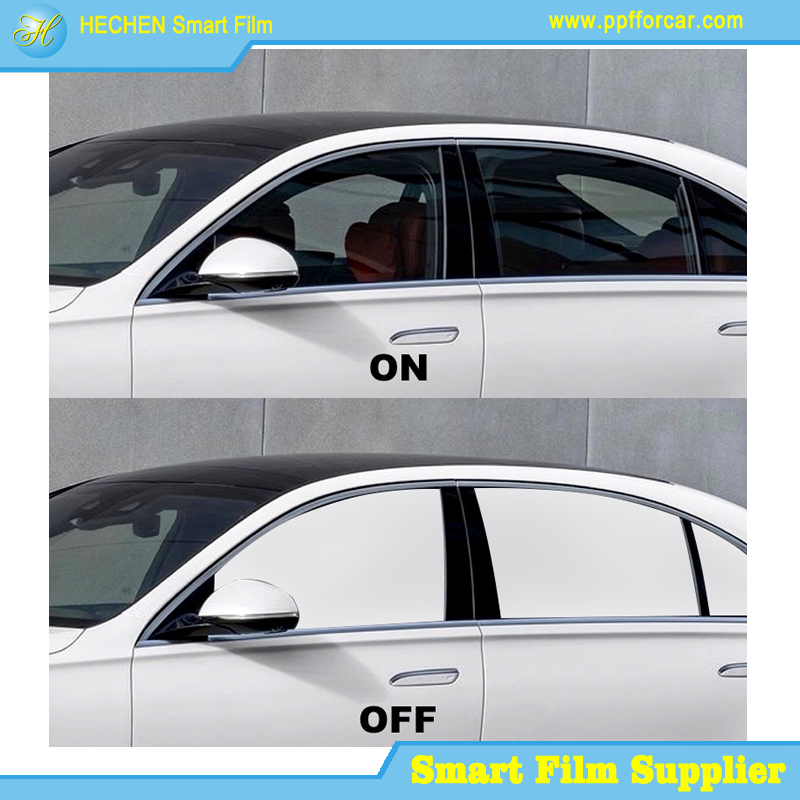
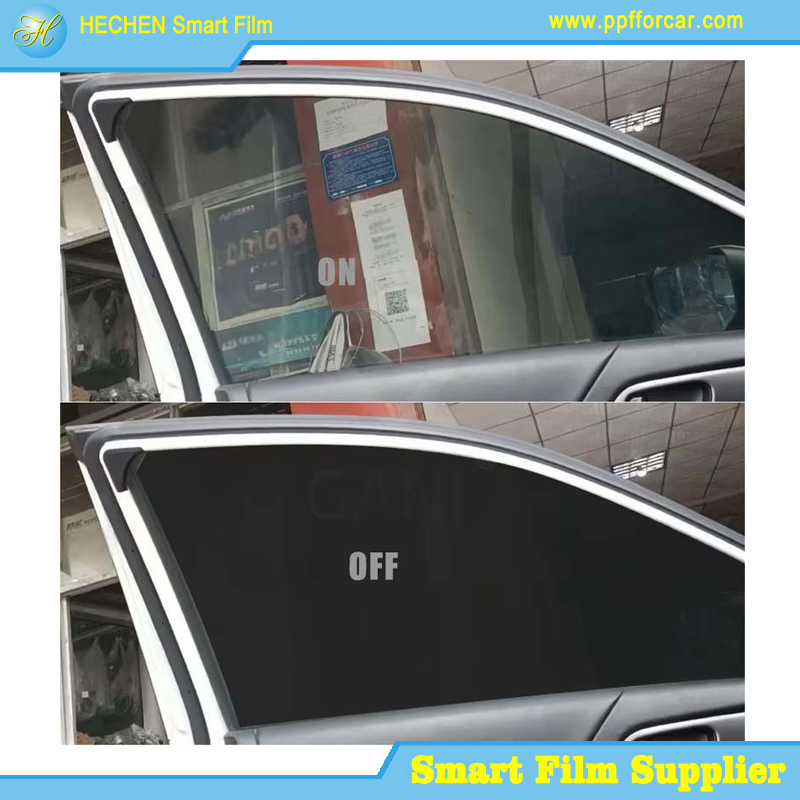
At the heart of PDLC technology is a thin, electrically switchable film that can be laminated into glass or applied as a retrofit. When powered off, the film scatters light into a translucent, frosted white state (opaque). When powered on (40–70 V AC), it becomes transparent. This binary switching capability—from clear to opaque in milliseconds—directly enables three major benefits for vehicle occupants: privacy, heat reduction, and UV protection. This article explains the science behind each benefit, quantifies real‑world performance, and addresses practical implementation.
2. Brief Operating Principle of PDLC Film
To understand the benefits, a short explanation of PDLC operation is necessary. The film consists of micron‑sized liquid crystal droplets dispersed in a solid polymer matrix. The polymer’s refractive index matches the ordinary index of the liquid crystal (~1.5) but not the extraordinary index. In the off‑state (no voltage), droplets are randomly oriented, causing light to scatter strongly—the film appears milky white with >90% haze. In the on‑state (AC voltage applied), liquid crystal molecules align with the electric field, presenting the extraordinary index to incident light, which now matches the polymer. Scattering ceases, and the film becomes transparent with <5% haze.
Key to the three benefits:
Privacy comes from the high‑scattering opaque state that prevents visual recognition of interior details.
Heat reduction arises from the scattering effect (which reflects a portion of solar energy outward) and from infrared‑absorbing additives integrated into the film.
UV protection is provided by the polymer matrix and, in laminated constructions, by UV‑absorbing interlayers (e.g., PVB) that block >99% of UVA and UVB.
3. Benefit 1: Instant On‑Demand Privacy
3.1 Mechanism
Privacy in PDLC is achieved not by absorption (darkening) but by scattering. In the opaque state, the film has a haze value >90%, meaning that less than 10% of light passes through without being scattered. The transmitted light is diffuse, creating a translucent barrier that obscures shapes, faces, and objects inside the vehicle. From outside, the window appears as a uniform, milky white or frosted surface. Critically, the film does not become black or dark—daylight still enters, maintaining a bright cabin.
3.2 Speed and Convenience
The switch from clear to opaque occurs in under 20 milliseconds (typically 10–20 ms). This instant response allows a driver to react to changing situations in real time: for example, when pulling into a parking lot in a busy area, a single button press renders all side windows and the sunroof opaque, hiding valuables and providing passenger privacy. When resuming driving, another press restores full transparency for optimal outward vision.
3.3 Comparison with Conventional Privacy Solutions
| Solution | Privacy Quality | Speed of Change | Mechanical Parts | Maintenance |
|---|---|---|---|---|
| PDLC film | Diffuse whiteout (no details visible) | Milliseconds | None | None (clean glass) |
| Static tint | Permanent darkening | Not changeable | None | None |
| Roller sunshade | Blocks view when deployed | Seconds (manual or motor) | Fabric, springs, motor | High (dust, wear) |
| Louvered blinds | Partial, adjustable | Seconds | Many moving parts | Very high |
PDLC offers the unique combination of instant switching and zero moving parts, making it highly reliable for automotive use.
3.4 Use Cases for Privacy
Parked vehicle security: Opaque windows deter smash‑and‑grab thieves by hiding bags, electronics, and other valuables.
VIP and executive transport: Rear passenger compartments can be isolated from outside view without blocking outward visibility for the occupants.
Changing or resting: Occupants can change clothes or take a nap without feeling exposed.
Nighttime privacy: When parked at night, PDLC in opaque state prevents passers‑by from seeing illuminated cabin interiors while still allowing diffused light from street lamps to enter.
4. Benefit 2: Heat Reduction (Solar Control)
4.1 How PDLC Reduces Heat
Heat entering a vehicle through windows comes primarily from solar radiation in three bands: ultraviolet (UV, ~5% of solar energy), visible light (~45%), and near‑infrared (NIR, ~50%). PDLC film addresses heat through two mechanisms:
Scattering in the opaque state: When the film is opaque, incident sunlight is scattered in all directions. A significant fraction of that scattered light is directed back out of the window (backscatter), reducing the total energy transmitted into the cabin. Depending on film thickness and droplet size, backscatter can reflect 40–60% of incoming visible and NIR radiation.
Infrared‑absorbing additives: Most automotive PDLC films incorporate nano‑particles or dyes that selectively absorb near‑infrared wavelengths (780–2500 nm). These additives work in both transparent and opaque states, providing continuous heat rejection even when the film is clear.
4.2 Quantified Heat Reduction Performance
Independent testing (representative, non‑branded) shows:
Total solar heat rejection (TSHR): PDLC film typically achieves 60–70% TSHR in the opaque state, and 50–60% in the transparent state. By comparison, standard automotive clear glass has TSHR of only 15–25%. High‑quality ceramic window tints reach 50–65% TSHR but are permanent.
Infrared rejection: 80–90% of NIR radiation (780–2500 nm) can be blocked, depending on the specific additive package.
Practical effect: On a summer day with ambient temperature 35 °C, a vehicle with PDLC film in opaque mode can have a cabin peak temperature 8–12 °C lower than a vehicle with clear glass, and 3–5 °C lower than one with standard tint. This reduces air conditioning load and improves electric vehicle range.
4.3 Glare Reduction as a Secondary Benefit
In the opaque state, PDLC scatters direct sunlight into diffuse light. This eliminates harsh glare on the driver’s eyes and on infotainment screens. While not a primary heat reduction mechanism, glare reduction improves comfort and safety.
4.4 Limitations: Heat Reduction in Transparent State
Because PDLC relies partly on scattering for heat rejection, its performance in the clear state is lower (though still superior to clear glass due to IR additives). For drivers who wish to keep windows transparent while still blocking heat, combining PDLC with a spectrally selective low‑E coating or using a dual‑pane insulated glass unit (with PDLC on the inner pane) can boost heat reduction in clear mode to near 70%.
5. Benefit 3: UV Protection
5.1 Mechanism of UV Blocking
Ultraviolet radiation is divided into UVA (315–400 nm) and UVB (280–315 nm). Both cause skin aging, eye damage, and degradation of interior materials (leather cracking, fabric fading, dashboard discoloration). PDLC film blocks UV through two layers:
The polymer matrix of the PDLC itself absorbs a portion of UV.
The PVB (polyvinyl butyral) interlayer used in laminated glass construction is formulated with UV absorbers that block virtually all UVA and UVB. Even in retrofit adhesive films (without PVB), the PET substrate and hard coating often include UV stabilizers.
5.2 Quantified Performance
UV blockage: >99% for wavelengths 280–400 nm when laminated with PVB. For adhesive‑only retrofit films, typical UV blockage is 95–98%.
SPF equivalence: A PDLC‑laminated window provides sun protection equivalent to SPF 50+ sunscreen for skin inside the vehicle.
Interior preservation: Tests show that after 1,000 hours of accelerated UV exposure, materials behind PDLC glass retain 90–95% of their original color and tensile strength, compared to less than 50% behind standard clear glass.
5.3 Continuous Protection
Crucially, PDLC blocks UV in both transparent and opaque states. The UV absorbers are passive and do not require electrical power. This means that even when the driver chooses the clear state for visibility, occupants and interior trim are fully protected from UV damage.
5.4 Comparison with Factory Tinted Glass
Many vehicles come with factory privacy glass (darkened rear windows). Such glass typically blocks only 60–80% of UV because it relies on absorption by the glass itself, which is less efficient than dedicated UV‑absorbing interlayers. PDLC laminated with PVB outperforms factory tint in UV protection while offering the added benefit of switchable opacity.
6. Additional Benefits Supporting the Core Three
While privacy, heat reduction, and UV protection are the headline advantages, several secondary benefits reinforce them:
No moving parts: Unlike mechanical sunshades that can jam or wear out, PDLC has no motors, cables, or fabric. This enhances long‑term reliability, especially in the harsh automotive environment (vibration, temperature extremes).
Low power consumption: The film consumes 3–6 W/m² only when transparent. If the film is kept opaque (privacy mode) most of the time, total energy use is negligible. For electric vehicles, this contributes to range preservation compared to air conditioning load reduction.
Fail‑safe privacy: In the event of a power failure (disconnected battery, blown fuse), the film defaults to the opaque state, maintaining privacy. This is a safety feature for parked vehicles.
Glare reduction (as noted): Direct sunlight is scattered, improving driver comfort.
Safety glass construction: When laminated, the glass holds shattered fragments, reducing injury risk during accidents.
7. Installation Options and Their Impact on Benefits
7.1 OEM Laminated Glass
UV protection: Best (>99%) due to PVB interlayer.
Heat reduction: Optimal, as film can be combined with IR‑reflective coatings on glass.
Privacy: Seamless, no visible wires or edges.
Durability: 10+ years.
7.2 Aftermarket Adhesive Film
UV protection: Slightly lower (95–98%), but still excellent.
Heat reduction: Similar to OEM if film quality is equivalent.
Privacy: Same optical effect, but busbars and wires may be visible.
Durability: 3–7 years (edge peeling, yellowing risk).
Retrofit film is a cost‑effective way to add PDLC benefits to an existing vehicle, but the lack of PVB lamination means UV protection is marginally lower and the film is less resistant to mechanical damage.
8. Limitations Related to the Three Benefits
No technology is perfect. The following limitations should be understood:
Heat reduction in transparent mode is moderate: While better than clear glass, PDLC in its clear state cannot match the heat rejection of a dedicated high‑performance ceramic tint or a suspended particle device (SPD) in its darkest state. For drivers who prioritize maximum heat rejection with clear glass appearance, combining PDLC with a low‑E coating is recommended.
Opaque state is white/frosted, not dark: Some users expect a dark, blacked‑out appearance for privacy. PDLC’s milky white appearance may not suit all aesthetic preferences. Dye‑doped PDLC (DPDLC) addresses this with a neutral dark opaque state, but it is less common.
Slight haze remains in clear state: Even when transparent, PDLC film has 3–6% haze. This is not noticeable to most drivers, but some may perceive a very faint milky quality when looking through the window at an angle.
UV protection for adhesive film may degrade over time: UV absorbers in adhesive films can eventually bleach, reducing protection to 80–90% after 5–7 years. OEM laminated glass with PVB does not suffer this degradation.
9. Comparison Summary Table
| Benefit | PDLC Performance | Comparison |
|---|---|---|
| Privacy | Instant (ms) opaque state, >90% haze, zero‑power | Superior to manual shades (faster); better than static tint (reversible) |
| Heat reduction | 60–70% TSHR (opaque), 50–60% (clear); IR block 80–90% | Comparable to ceramic tint in opaque mode; slightly lower in clear mode |
| UV protection | >99% (laminated), 95–98% (adhesive) | Superior to factory privacy glass (60–80%); equal to best window films |
10. Future Improvements
Research continues to enhance the three core benefits:
Dye‑doped PDLC for dark, neutral opaque states that absorb rather than scatter, improving heat rejection in opaque mode.
Multi‑layer PDLC combining two switchable layers to achieve intermediate transparency levels and higher backscatter for heat rejection.
Self‑cleaning and anti‑fog coatings added to PDLC surfaces to maintain optical clarity.
Integration with vehicle sensors: Automatically switching to opaque mode when parked in direct sunlight to reduce cabin heat (heat reduction benefit) and switching to clear when the driver approaches (privacy on demand).
11. Conclusion
PDLC smart film delivers three tangible, quantifiable benefits to automotive glazing: instant on‑demand privacy, significant solar heat reduction, and near‑complete UV protection. These benefits arise from the film’s unique electro‑optical properties—scattering in the opaque state, IR‑absorbing additives, and UV‑blocking interlayers. Unlike static tints, PDLC preserves the ability to enjoy clear views and natural daylight when privacy is not required. Unlike mechanical shades, it has no moving parts and switches in milliseconds. While limitations exist (moderate heat rejection in clear state, slight residual haze, white opaque appearance), PDLC remains the most practical and cost‑effective switchable glazing technology for automotive applications where rapid, binary privacy and passive UV protection are priorities. As dye‑doped and multi‑layer variants mature, these benefits will only expand, making PDLC a standard feature in the next generation of intelligent vehicle windows.
Key Takeaways
Privacy benefit: PDLC switches from clear to opaque in <20 ms, achieving >90% haze and complete visual obscuration without moving parts. Power is zero in opaque mode (fail‑safe privacy).
Heat reduction benefit: Total solar heat rejection reaches 60–70% in opaque state and 50–60% in clear state, thanks to scattering backscatter and IR‑absorbing nanoparticles. This lowers peak cabin temperature by 8–12 °C and reduces A/C load.
UV protection benefit: Laminated PDLC glass blocks >99% of UVA and UVB (SPF 50+ equivalent), protecting occupants and preventing interior fading. Protection is continuous in both transparent and opaque states.
Installation matters: OEM laminated glass offers the highest UV protection (>99%) and durability (10+ years). Aftermarket adhesive film provides similar privacy and heat reduction but slightly lower UV protection (95–98%) and shorter lifespan (3–7 years).
Limitations to know: Clear state retains 3–6% haze; opaque state appears milky white (not black); heat reduction in clear mode is moderate compared to dedicated ceramic tints; extreme temperatures can slow switching.
Future direction: Dye‑doped PDLC will deliver dark opaque states with enhanced heat rejection; lower‑voltage operation (12 V DC) will simplify integration; multi‑layer films may enable variable dimming.
For more about PDLC Film for Cars: Benefits for Privacy, Heat Reduction & UV Protection. Everything you need to know, you can pay a visit to https://www.ppfforcar.com/product/PDLC-Smart-Film/ for more info.


评论
发表评论