PDLC Film for Cars Explained: Instant Switch from Opaque to Clear
TL;DR: Polymer Dispersed Liquid Crystal (PDLC) film is an electro‑optical smart glazing technology that enables automotive windows to switch instantly between a translucent, opaque (frosted) state and a fully transparent state at the press of a button. Unlike conventional window tints or mechanical sunshades, PDLC film requires no moving parts and consumes power only when transparent (≈3–6 W/m²). This article explains the underlying physics of refractive index mismatch, the electrical drive requirements (40–70 V AC, derived from the vehicle’s 12 V DC system), key performance parameters (switching speed <100 ms, >90% haze in opaque state, >99% UV blocking), benefits such as on‑demand privacy, solar heat reduction, glare control, and interior preservation, as well as installation methods (OEM laminated glass vs. aftermarket retrofit) and current limitations. The focus is on the instant, binary switching characteristic that distinguishes PDLC from other smart glass technologies.
1. Introduction
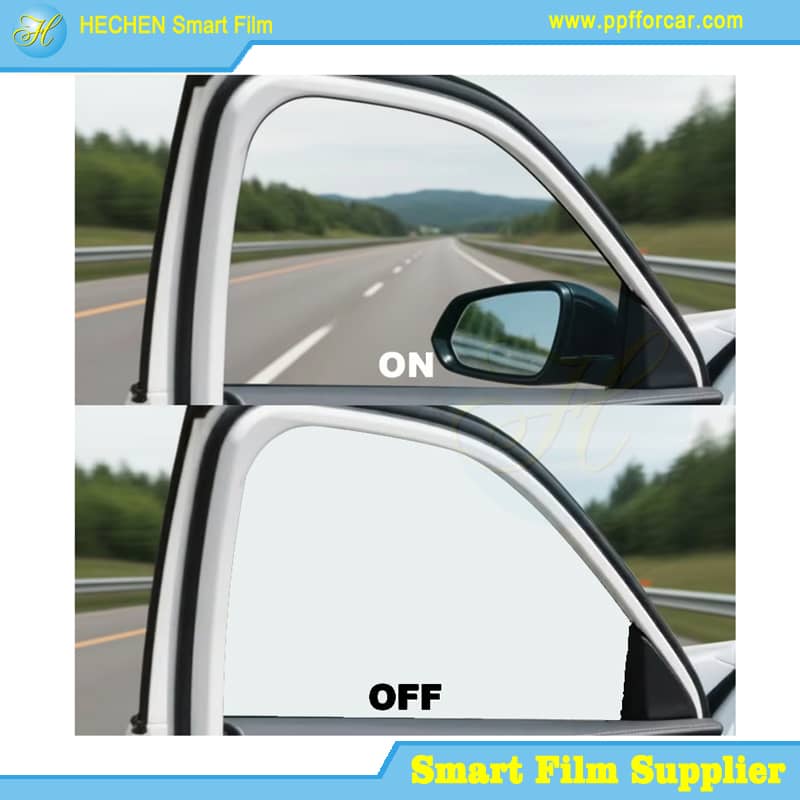
Imagine driving on a bright sunny day: the sunroof above you is clear, bathing the cabin in natural light. Then, as the sun shifts and glare becomes uncomfortable, you touch a button. Within a fraction of a second, the glass above turns into a soft, milky white surface that scatters the harsh rays while still letting in diffused illumination. This is not science fiction; it is the daily reality of PDLC (Polymer Dispersed Liquid Crystal) smart film for car glazing.
The phrase “instant switch from opaque to clear” captures the essence of PDLC technology. Unlike electrochromic glass that may take tens of seconds or minutes to change tint, or mechanical shades that whir and grind, PDLC film transitions in milliseconds. It offers a binary choice: fully transparent or fully opaque (frosted). This binary, near‑instantaneous response makes PDLC uniquely suited for applications where rapid adaptation to changing lighting or privacy needs is essential—such as sunroofs, side windows, rear windows, and interior privacy partitions in vehicles.
2. What Is PDLC Film? – Structure and Composition
PDLC film is a thin, flexible multilayer composite, typically 0.2–0.4 mm in thickness. Its core functional layer consists of micrometer‑sized droplets of liquid crystal uniformly dispersed within a solid polymer matrix. This polymer‑dispersed liquid crystal layer is sandwiched between two transparent conductive electrodes, most commonly made of indium tin oxide (ITO) coated onto polyester (PET) substrates. The entire stack is then either laminated between two glass panes for original equipment manufacturer (OEM) applications or supplied as a self‑adhesive film for aftermarket installation.
In the absence of an electric field, the liquid crystal droplets are randomly oriented. The polymer matrix is formulated to match the ordinary refractive index of the liquid crystal (≈1.5), but the random orientation means that light encounters regions with the extraordinary index (≈1.7), causing strong scattering. The film appears opaque or “frosted” white.
When an alternating current (AC) voltage is applied across the ITO layers, the resulting electric field forces the liquid crystal molecules to align uniformly with the field direction. Now the extraordinary index (≈1.7) becomes the only index seen by light traveling parallel to the field, and it matches the polymer’s index, eliminating scattering. The film becomes clear.
3. How Does PDLC Achieve Instant Switching?
3.1 The Physics of Refractive Index Matching
The switching speed of PDLC is determined by the rotational viscosity of the liquid crystal and the droplet size. Typical liquid crystal mixtures have rotational viscosities on the order of 50–200 mPa·s. Droplet diameters range from 0.5 to 5 μm. When the electric field is applied, the torque on each molecule aligns it with the field in a time scale given by τ ≈ γ / (Δε E²), where γ is rotational viscosity, Δε is the dielectric anisotropy, and E is the electric field strength. With fields of approximately 5–10 V/μm, alignment times fall into the 10–100 ms range.
When the field is removed, the liquid crystal relaxes back to its random orientation due to elastic restoring forces and anchoring to the polymer walls. This relaxation is even faster, typically <20 ms. Thus, the transition from opaque to clear (on‑state) and clear to opaque (off‑state) both happen in well under one second—hence “instant switch”.
3.2 Electrical Drive Requirements
PDLC film requires an AC voltage to prevent electrochemical degradation of the liquid crystal and ITO layers. The operating voltage typically ranges from 40 to 70 V AC at 50 or 60 Hz. Automotive electrical systems supply 12 V DC, so a small electronic driver (inverter) is needed to convert DC to AC and step up the voltage. These drivers are compact, efficient (typically >85% efficiency), and designed to be installed in the vehicle’s headliner, door panel, or center console.
Power consumption is remarkably low. In the transparent state, the film consumes 3–6 W per square meter. For a typical panoramic sunroof of about 1 m², that is less than 6 W—comparable to a single LED map light. In the opaque state, consumption is zero. This means that even if the film is kept clear for an entire hour of driving, it uses less energy than turning on the air conditioning for one minute.
3.3 Temperature Effects on Switching Speed
Automotive environments range from –30 °C (cold start) to +70 °C (cabin interior on a hot summer day). At low temperatures, the viscosity of the liquid crystal increases, which can slow the switching time from milliseconds to perhaps 200–300 ms. The film still switches reliably, but the transition may appear slightly sluggish. High temperatures decrease viscosity, making switching even faster. Automotive‑grade PDLC films are formulated with wide‑temperature liquid crystal mixtures and polymer matrices to maintain function across the entire range, typically –30 °C to +70 °C, with some versions extending to –40 °C to +90 °C.
4. Key Technical Specifications
| Parameter | Typical Automotive Grade Value |
|---|---|
| Operating voltage | 40–70 V AC, 50/60 Hz |
| Power consumption (clear state) | 3–6 W/m² |
| Switching time (opaque→clear) | 10–100 ms |
| Switching time (clear→opaque) | <20 ms |
| Visible transmittance – clear state | 70–85% |
| Visible transmittance – opaque state (diffuse) | 55–65% |
| Haze – clear state | <5–6% |
| Haze – opaque state | >90% |
| UV blocking (with PVB interlayer) | >99% |
| IR blocking (solar heat reduction) | 60–90% (formulation dependent) |
| Operating temperature | –30 °C to +70 °C (extended: –40 °C to +90 °C) |
| Viewing angle | >140° |
| Switching cycles (lifespan) | >50,000 |
5. Benefits of Instant Switch from Opaque to Clear
5.1 On‑Demand Privacy Without Mechanical Parts
The most obvious benefit is privacy. When the vehicle is parked, the driver can switch side windows or the sunroof to the opaque state, preventing passers‑by from seeing inside. For VIP limousines or executive cars, PDLC partitions between the front and rear seats provide instant discretion. Unlike roller blinds or curtains, PDLC has no cords, motors, or fabric to collect dust or break. The entire system is solid‑state, offering exceptional reliability.
5.2 Solar Heat Reduction and Glare Control
In the opaque state, the PDLC film scatters incoming sunlight, turning direct glare into soft, diffuse illumination. This reduces eye strain and makes the cabin more comfortable. Moreover, the scattering effect sends a significant portion of solar energy back outward, reducing heat buildup. Combined with the film’s inherent infrared (IR) blocking capability (60–90% depending on additives), PDLC can lower peak cabin temperatures by several degrees Celsius, easing the load on the vehicle’s air conditioning system. For electric vehicles, this translates directly into extended driving range.
5.3 UV Protection for Occupants and Interiors
PDLC film, when laminated with UV‑absorbing PVB (polyvinyl butyral) interlayers, blocks more than 99% of harmful ultraviolet radiation (both UVA and UVB). This protection is passive and continuous, regardless of whether the film is in the clear or opaque state. It prevents fading of leather seats, cracking of dashboards, and reduces skin exposure risk for passengers.
5.4 Preservation of Natural Light and Views
Unlike traditional dark window tints that permanently reduce visibility, PDLC film preserves the ability to enjoy clear views and full daylight when desired. The instant switch feature means that the driver can adapt to changing conditions: clear for a scenic drive, opaque for a midday rest or parking in a busy area. No other technology offers this combination of speed and flexibility.
5.5 Enhanced Safety (Laminated Construction)
In OEM installations, the PDLC film is laminated between two glass layers. This creates a safety glass construction that holds shattered fragments together during an accident or attempted break‑in, preventing dangerous shards from flying into the cabin. The laminated structure also adds a degree of sound insulation, reducing road noise.
6. Installation Methods
6.1 OEM Laminated Glass (Factory Installation)
The most robust and aesthetically pleasing method is to have PDLC film laminated into the glass during manufacturing. The process: two sheets of tempered or annealed glass, a layer of PVB, the PDLC film, another PVB layer, and the second glass sheet are bonded under heat and pressure. The resulting unit is fully sealed, weatherproof, and can be curved to match vehicle contours. Electrical connections are integrated into the glass edge and routed through the vehicle’s wiring harness. This method is used for panoramic sunroofs, rear windows, and privacy partitions in high‑end vehicles.
6.2 Aftermarket Retrofit Adhesive Film
For existing vehicles, self‑adhesive PDLC film can be applied to the interior side of clear glass. The film has a pressure‑sensitive adhesive layer protected by a release liner. After cleaning the glass, the film is applied like a large decal, carefully avoiding bubbles. Thin copper busbars are attached to two opposite edges of the film, and wires are routed to a driver and control switch. While cheaper than full glass replacement, aftermarket installation has drawbacks: exposed wires, risk of edge peeling, potential for bubbles, and generally lower UV durability (yellowing over time). Lifespan is typically 3–7 years, versus 10+ years for OEM laminated glass.
6.3 Power and Control Integration
A typical retrofit installation includes:
PDLC film cut to window dimensions
Two adhesive busbars (copper or silver‑printed)
Micro‑thin wires (0.5 mm²) run along window frames
A 12 V DC to 40–70 V AC driver (inverter) – often concealed under dashboard or inside door panel
A control switch (momentary or latching) – can be mounted on door panel or center console
Optional: smart controller for integration with CAN bus, remote key fob, or smartphone app.
For OEM installations, the driver is often integrated into the vehicle’s body control module, and the switch may be a capacitive touch panel on the overhead console.
7. Comparison with Other Smart Glass Technologies
| Technology | Switching Speed | Opacity Range | Power Consumption | Opaque Appearance | Cost |
|---|---|---|---|---|---|
| PDLC | Milliseconds | Binary (clear/opaque) | 3–6 W/m² (clear only) | Milky white / frosted | Low–medium |
| SPD (Suspended Particle Device) | 100–300 ms | Continuous dimming | ~5–10 W/m² (darkest) | Dark / blue‑grey | High |
| EC (Electrochromic) | 30 s – 5 min | Continuous dimming | <0.5 W/m² (steady state) | Dark / neutral | Very high |
PDLC’s key differentiator is the instant switch from opaque to clear (and back). SPD also switches relatively quickly but requires power to stay clear (dark state is zero‑power), whereas PDLC is zero‑power in opaque. EC is extremely slow but ultra‑low power. For applications where rapid, binary privacy control is paramount—such as a sunroof that needs to react to sudden glare or a side window that should instantly become private when parking—PDLC is the optimal choice.
8. Limitations and Considerations
Slight haze in clear state: Even when fully transparent, PDLC film retains a small amount of haze (3–6%), which some users perceive as a faint milky quality. This is inherent to the polymer‑liquid crystal composite and is noticeable only when comparing directly to clear glass.
Binary only: PDLC cannot be dimmed to intermediate levels (e.g., 50% transparency) without rapid pulsing, which reduces film life and is rarely implemented.
Viewing angle dependence: At oblique angles (greater than 60° from normal), the clear state may appear hazy due to increased path length through the scattering layer.
Temperature sensitivity: Extreme cold slows switching; extreme heat (above 70 °C) can accelerate long‑term degradation if the film lacks proper UV/IR protection.
Power requirement for clear state: Unlike traditional tint that is always dark, PDLC requires power to stay clear. In practice, the power consumption is tiny, but it does mean that if the vehicle’s battery is disconnected, the film defaults to opaque (fail‑safe privacy).
9. Future Developments
Research and development in PDLC film for automotive use is active. Key trends include:
Dye‑doped PDLC (DPDLC): Adding dichroic dyes to the liquid crystal mixture produces a dark, neutral‑tone opaque state instead of milky white, improving aesthetics and contrast.
Lower‑voltage operation: Formulations that switch at 12–24 V DC would eliminate the need for an inverter, simplifying installation and reducing cost.
Flexible and curved films: Improved polymer matrices allow PDLC to be applied to highly curved glass surfaces without delamination.
Integrated IR rejection: Nano‑composite coatings applied to the PDLC film itself to boost solar heat rejection to >90% without affecting visible transparency.
Key Takeaways
Instant switching: PDLC film transitions between opaque and clear in 10–100 milliseconds, faster than any competing smart glass technology (SPD or electrochromic).
How it works: Randomly oriented liquid crystal droplets scatter light (opaque); applied AC voltage (40–70 V) aligns them, eliminating scattering (clear). Power is needed only for the clear state (3–6 W/m²).
Core benefits: Provides instant on‑demand privacy (>90% haze when opaque), blocks >99% of UV radiation, reduces solar heat gain by up to 70%, and converts direct glare into soft diffused light.
Installation options: OEM laminated glass offers superior durability and seamless integration; aftermarket adhesive films provide a lower‑cost retrofit path but with exposed wiring and shorter lifespan (3–7 years).
Limitations: Slight haze (3–6%) remains in the clear state; binary on/off only (no dimming); performance can slow at extreme low temperatures (–30 °C) and degrade above 70 °C.
Future direction: Dye‑doped PDLC for dark, neutral opaque tones; lower‑voltage (12 V DC) operation to eliminate inverters; enhanced IR rejection for better thermal management.
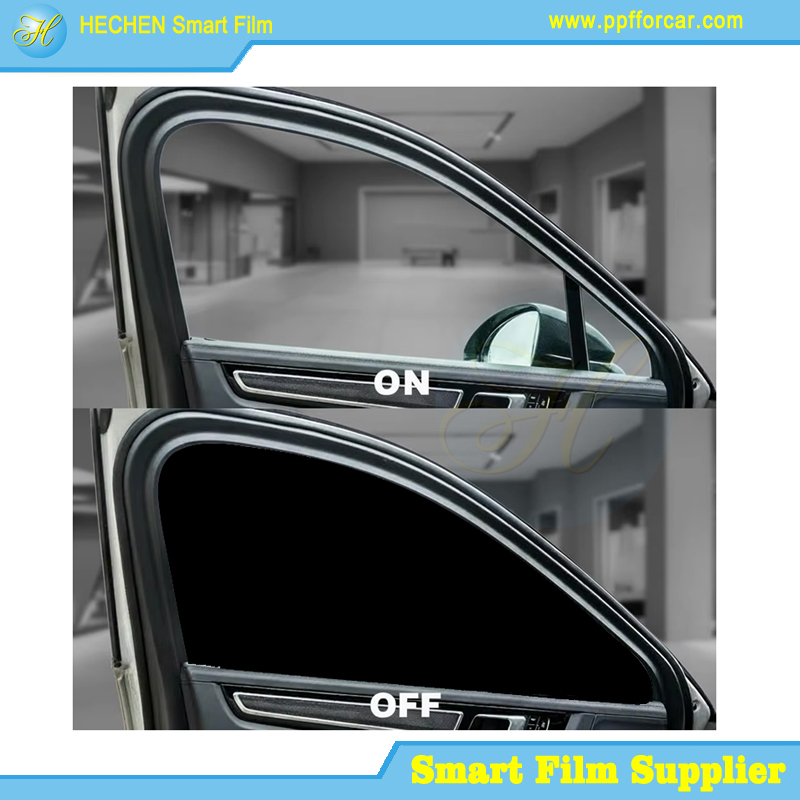
PDLC smart film delivers exactly what its name promises: an instant, electrically controlled switch between opaque and clear states for automotive windows. By harnessing the physics of liquid crystal alignment and refractive index mismatch, it achieves switching times of 10–100 milliseconds, consumes negligible power, and provides on‑demand privacy, UV protection, glare reduction, and solar heat management. Whether integrated as OEM laminated glass or retrofitted as an adhesive film, PDLC offers a solid‑state, maintenance‑free alternative to mechanical shades and static tints. While it has limitations—slight residual haze and binary operation—its unique combination of speed, simplicity, and cost‑effectiveness makes it the preferred smart glass technology for applications where rapid adaptation to lighting and privacy needs is essential. As dye‑doped and low‑voltage variants mature, PDLC is poised to become a standard feature in next‑generation automotive glazing.
For more about PDLC Film for Cars Explained: Instant Switch from Opaque to Clear. Everything you need to know, you can pay a visit to https://www.ppfforcar.com/product/PDLC-Smart-Film/ for more info.


评论
发表评论