PDLC Film for Cars vs Ceramic Tint: Which One Should You Choose?
TL;DR: This article compares two leading automotive glazing solutions—PDLC smart film and ceramic window tint—across critical performance metrics: privacy control, heat rejection, UV protection, optical clarity, durability, and user experience. PDLC film offers instant, electrically switchable privacy (opaque/clear in milliseconds), zero‑power privacy mode, and >99% UV protection, but requires an electrical connection and has slight residual haze when clear. Ceramic tint provides permanent, maintenance‑free heat rejection (up to 80‑90% infrared block) and excellent UV protection without electricity, but cannot be switched to clear and has a fixed dark appearance. After a detailed technical comparison, this article concludes that PDLC film is the superior choice for drivers who value on‑demand privacy, the ability to enjoy clear views when desired, and future‑proof smart glazing integration—despite higher initial cost and installation complexity.
1. Introduction
Automotive window treatments have evolved far beyond simple dyed films. Today, vehicle owners can choose between advanced ceramic nano‑particle tints that provide passive heat and UV rejection, or PDLC (Polymer Dispersed Liquid Crystal) smart film that actively switches between transparent and opaque states. Both technologies offer significant improvements over conventional films, but they serve fundamentally different user needs.
This article provides a systematic, side‑by‑side comparison of PDLC film and ceramic tint. We examine their working principles, performance in heat reduction, UV protection, privacy functionality, optical quality, durability, installation requirements, and cost. The goal is to help readers understand the trade‑offs and, based on the evidence, arrive at a reasoned conclusion. The final recommendation will favor PDLC film for a specific set of priorities—namely, those who demand switchable privacy and the flexibility of clear glass on demand.
2. Brief Overview of Each Technology
2.1 PDLC Smart Film
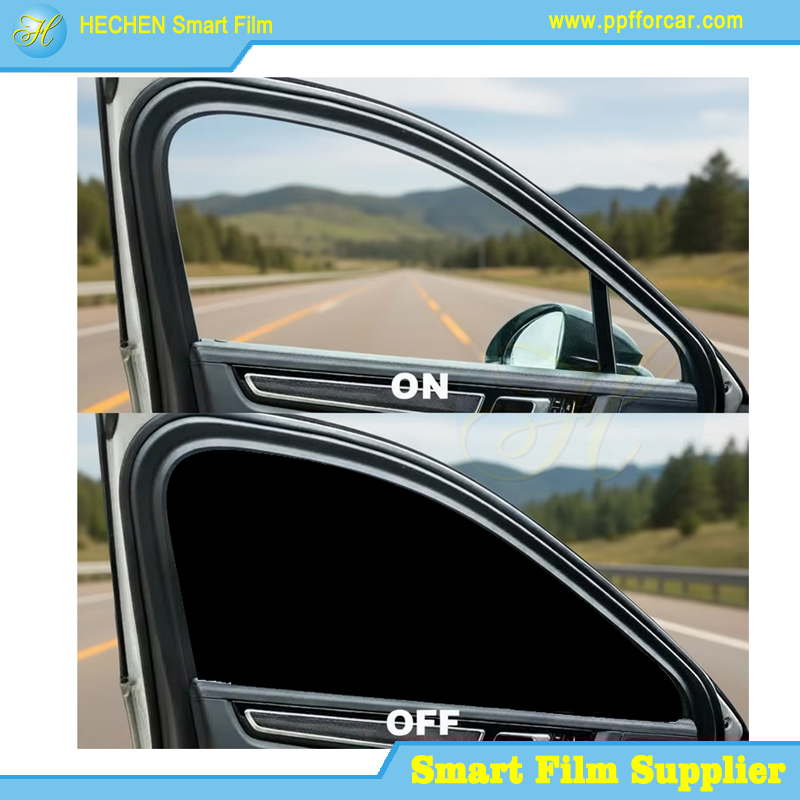
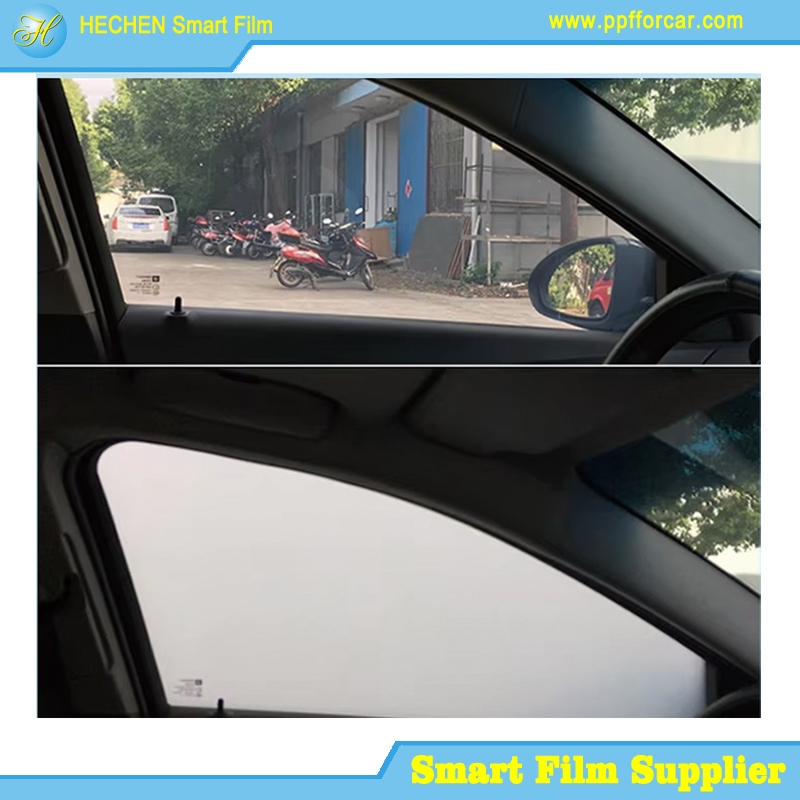
PDLC film is an electro‑optical composite consisting of liquid crystal droplets dispersed in a polymer matrix, sandwiched between transparent conductive layers. When no voltage is applied, the liquid crystals are randomly oriented, scattering light into a translucent, milky white state (opaque). When AC voltage (40–70 V) is applied, the crystals align, eliminating scattering and making the film transparent. Switching occurs in 10–100 milliseconds.
Key characteristics:
Binary states: Fully transparent or fully opaque (frosted white).
Power required only for transparent state: 3–6 W/m².
Fail‑safe: Defaults to opaque (privacy) on power loss.
Installation: Requires electrical wiring and a driver (inverter).
2.2 Ceramic Window Tint
Ceramic tint is a non‑metallic, non‑dyed film that incorporates nano‑ceramic particles (e.g., titanium nitride or antimony tin oxide) into a polyester substrate. These particles selectively absorb and reflect infrared radiation while allowing visible light to pass through. The tint is applied as a permanent adhesive film to the interior side of existing glass. It has no electrical components and does not change its optical properties.
Key characteristics:
Fixed darkness level: Available in various visible light transmission (VLT) percentages (e.g., 20%, 35%, 50%).
No switching capability: Always at the chosen tint level.
Passive operation: No power required.
Installation: Simple adhesive application, no wiring.
3. Head‑to‑Head Comparison
3.1 Privacy Control
| Aspect | PDLC Film | Ceramic Tint |
|---|---|---|
| Privacy mode | Instant opaque (frosted white) with >90% haze | Permanently dark (e.g., 20% VLT) |
| Ability to have clear glass | Yes, at the flip of a switch | No – cannot become clear |
| Daytime privacy (outside looking in) | Excellent in opaque state | Good, but depends on VLT; darker = more privacy |
| Nighttime privacy (inside looking out) | In opaque state, view is diffused but still bright; in clear state, full view | Reduced night vision due to fixed darkness |
Analysis: PDLC offers true on‑demand privacy. When you want to see out clearly (e.g., while driving at night), you switch to transparent. When you park or need seclusion, you switch to opaque. Ceramic tint forces a compromise: darker tints give privacy but impair night driving; lighter tints preserve visibility but offer less privacy. PDLC wins for flexibility.
3.2 Heat Reduction (Solar Rejection)
Both technologies reduce solar heat, but through different mechanisms.
| Metric | PDLC Film | Ceramic Tint |
|---|---|---|
| Total Solar Heat Rejection (TSHR) – opaque state | 60–70% | N/A (no opaque state) |
| TSHR – clear state | 50–60% | 50–80% (depending on VLT; darker = higher TSHR) |
| Infrared (IR) rejection | 80–90% (with additives) | 85–95% typical |
| Mechanism | Scattering (opaque) + IR absorption | IR absorption/reflection (passive) |
| Dependence on state | Clear state has lower TSHR | Constant TSHR |
Analysis: Ceramic tint generally provides higher and more consistent heat rejection, especially in its darkest formulations. However, PDLC in its opaque state offers comparable or even superior TSHR (60–70%) due to strong backscatter. In clear state, PDLC’s heat rejection (50–60%) is still much better than clear glass (15–25%) and sufficient for most driving conditions. For maximum heat rejection at all times, ceramic tint has an edge. But for many users, PDLC’s clear‑state performance is acceptable, and the ability to switch to opaque for parking dramatically reduces cabin heat buildup.
3.3 UV Protection
| Aspect | PDLC Film | Ceramic Tint |
|---|---|---|
| UV blockage (laminated OEM) | >99% | >99% (most quality ceramics) |
| UV blockage (retrofit adhesive) | 95–98% | >99% |
| Durability of UV protection | Permanent in laminated form | Permanent (ceramic particles do not degrade) |
Analysis: Both technologies excel at UV protection. High‑quality ceramic tint blocks >99% of UVA/UVB. PDLC laminated with PVB also achieves >99%. This is essentially a tie.
3.4 Optical Clarity and Haze
| Aspect | PDLC Film | Ceramic Tint |
|---|---|---|
| Clarity in transparent/clear state | Slight haze (3–6%) – may be noticed on white backgrounds or at angles | Virtually zero haze (<1%); crystal clear |
| Color neutrality | Slight warm or neutral tint possible; white opaque state | Neutral grey or slightly blue/green; no color distortion in quality films |
| Viewing angle dependence | Haze increases beyond 60° off‑axis | No angle dependence |
Analysis: Ceramic tint provides superior optical clarity when looking through the glass. PDLC’s residual haze is a trade‑off for its switchability. For drivers who are highly sensitive to optical imperfections, ceramic tint may feel more natural. However, most users do not notice the 3–6% haze in everyday driving.
3.5 Aesthetics – Exterior Appearance
| Aspect | PDLC Film – Opaque | PDLC Film – Clear | Ceramic Tint |
|---|---|---|---|
| Exterior look | Milky white, frosted, highly visible “smart glass” look | Nearly clear (slight haze) | Dark, uniform, traditional tinted look |
| Privacy perception | High (looks like frosted glass) | Low | Medium to high depending on VLT |
Analysis: This is subjective. Some prefer the high‑tech, frosted white appearance of PDLC in privacy mode; others prefer the classic dark, stealthy look of ceramic tint. PDLC in clear mode is almost indistinguishable from untinted glass, which may be desirable for those who dislike dark windows.
3.6 Durability and Lifespan
| Aspect | PDLC Film | Ceramic Tint |
|---|---|---|
| OEM laminated | 10–15 years | N/A (ceramic is always adhesive film) |
| Aftermarket adhesive | 3–7 years (edge peeling, yellowing) | 5–10 years (no moving parts, but can scratch) |
| Resistance to scratching | Moderate (hard coating helps) | Moderate to high (some have scratch‑resistant layers) |
| Failure modes | Electrical driver failure, delamination, yellowing | Peeling, bubbling (poor installation), scratching |
Analysis: Ceramic tint has a longer proven track record and fewer failure modes because it has no electrical components. PDLC’s longevity has improved but still depends on the quality of the driver and edge sealing. For OEM laminated PDLC, lifespan is comparable to ceramic tint. For aftermarket adhesive PDLC, ceramic tint is more durable.
3.7 Installation Complexity and Cost
| Aspect | PDLC Film | Ceramic Tint |
|---|---|---|
| Installation difficulty | High – requires wiring, driver, switch; often professional only | Low – adhesive application, can be DIY or professional |
| Installation time | Several hours (electrical work) | 1–2 hours for full vehicle |
| Cost (materials + labor) | High ($800–2500+ for full vehicle) | Medium ($300–800 for full vehicle) |
Analysis: Ceramic tint is significantly cheaper and easier to install. PDLC represents a premium investment.
3.8 Energy Consumption and Environmental Impact
| Aspect | PDLC Film | Ceramic Tint |
|---|---|---|
| Power consumption | 3–6 W/m² only when transparent | 0 W |
| Effect on EV range | Reduces A/C load (positive); small power draw (negative) – net positive in hot climates | Reduces A/C load; no power draw |
Analysis: Both reduce air conditioning energy use. PDLC’s own power draw is negligible. In hot climates, the ability to switch to opaque while parked reduces cabin temperatures significantly, lowering the initial A/C burst energy. Ceramic tint provides constant passive benefit.
4. Why Choose PDLC Film? – The Deciding Factors
After a balanced comparison, PDLC film is the superior choice for drivers who prioritize the following:
4.1 On‑Demand Privacy Without Permanent Darkness
Ceramic tint forces you to accept a fixed level of darkness at all times. At night, this reduces outward visibility and can be unsafe. During the day, you may want a clear, unobstructed view of scenery. PDLC gives you both: crystal clear when you want it, complete privacy when you need it. This is especially valuable for:
Families with children who nap in the car (opaque during rest, clear while driving).
Ride‑share or taxi drivers who want passenger privacy on demand.
Road trip enthusiasts who want to enjoy panoramic views but also need changing areas or secure parking.
4.2 Instant, Solid‑State Reliability
PDLC has no moving parts. Unlike mechanical shades that jam or wear out, PDLC switches electronically. The failure rate of quality PDLC drivers is extremely low. And because the film defaults to opaque on power loss, you never lose privacy unexpectedly.
4.3 Future‑Proof Smart Vehicle Integration
As vehicles become more connected, PDLC can be integrated with:
Sunload sensors: Automatically switch to opaque when intense sunlight is detected.
Parking mode: Switch all windows opaque when the vehicle is parked and locked.
Voice control: “Hey car, make the rear windows private.”
Geofencing: Switch to clear when entering a scenic zone, opaque when entering a city center.
Ceramic tint offers no such smart capabilities.
4.4 Preserving Nighttime Visibility and Safety
One of the most overlooked dangers of dark ceramic tint is reduced night vision. PDLC in clear mode at night provides 70–85% visible transmittance—far safer than 20% VLT ceramic tint. You can have privacy during the day (opaque state) and full visibility at night (clear state). This is a critical safety advantage.
4.5 Resale Value and Customization
A vehicle with factory‑integrated PDLC smart glass (or a professional retrofit) is a unique selling point. It signals modernity and luxury. Ceramic tint is common and adds little to resale value. Moreover, PDLC allows the next owner to choose their own privacy level—not be stuck with your tint darkness preference.
5. When Should You Choose Ceramic Tint Instead?
To be fair, ceramic tint remains a good choice for:
Budget‑conscious buyers who cannot afford PDLC’s premium cost.
Owners of older vehicles where electrical installation is impractical.
Drivers who want maximum constant heat rejection and do not mind a permanently dark appearance.
Those who dislike any haze and demand perfect optical clarity.
But for most modern vehicle owners who value flexibility, safety, and technology, PDLC is the forward‑looking choice.
6. Installation Recommendations for PDLC
If you choose PDLC, consider:
OEM laminated glass for best durability, UV protection (>99%), and seamless appearance. If not available from factory, aftermarket retrofit adhesive film is an option.
Professional installation is strongly recommended for wiring and driver placement.
Combine with ceramic tint on non‑switchable windows (e.g., rear quarter windows that rarely need to be clear) to save cost while still getting heat rejection.
7. Conclusion
The choice between PDLC film and ceramic tint ultimately depends on your priorities. Ceramic tint offers excellent passive heat rejection, high UV protection, and lower cost, but it permanently darkens your windows and cannot provide clear views on demand. PDLC film, while more expensive and requiring electrical installation, delivers instant switchable privacy, preserves nighttime visibility, enables smart automation, and offers the unique ability to enjoy clear glass when desired.
For drivers who value flexibility, safety, and the latest automotive technology, PDLC film is the superior choice. The ability to go from completely private to crystal clear in milliseconds, without mechanical shades or permanent darkness, transforms the driving and ownership experience. As PDLC technology continues to mature—with lower costs, dye‑doped dark opaque states, and simplified 12 V DC operation—it will likely become the standard for premium automotive glazing. Choose PDLC if you want the best of both worlds: privacy and clarity, on your terms.
Key Takeaways
PDLC offers switchable privacy; ceramic tint is permanent. PDLC can become clear or opaque instantly; ceramic tint has a fixed darkness level that cannot be changed.
Heat rejection: Ceramic tint typically provides higher and more consistent TSHR (50–80%) than PDLC in clear state (50–60%). However, PDLC in opaque state achieves 60–70% TSHR, excellent for parked cooling.
UV protection is excellent in both: Both technologies block >99% of UV when high‑quality materials are used (laminated PDLC vs. ceramic film).
Optical clarity: Ceramic tint has near‑zero haze; PDLC has slight residual haze (3–6%) in clear state, noticeable only on close inspection.
Nighttime safety: PDLC in clear mode provides 70–85% visible transmittance, far safer than dark ceramic tint (e.g., 20% VLT). PDLC preserves night vision.
Cost and complexity: PDLC is more expensive ($800–2500+) and requires professional electrical installation; ceramic tint is cheaper ($300–800) and simpler to apply.
Why choose PDLC: If you want on‑demand privacy, the ability to have clear glass, smart home/vehicle integration, and the safety of full nighttime visibility, PDLC is the superior choice despite higher upfront cost.
Why choose ceramic tint: If you have a tight budget, don’t need switchable privacy, prefer a constant dark look, and want maximum heat rejection without any haze, ceramic tint is a solid alternative.
For more about PDLC Film for Cars vs Ceramic Tint: Which One Should You Choose? Everything you need to know, you can pay a visit to https://www.ppfforcar.com/product/PDLC-Smart-Film/ for more info.


评论
发表评论