PDLC Film for Cars: What Is It and How Does It Work?
1. Introduction
Modern automotive design increasingly prioritizes passenger comfort, privacy, and energy efficiency. Conventional solutions for solar control and privacy—such as static window films, roller sunshades, and mechanical blinds—offer fixed performance and often introduce mechanical complexity, maintenance burdens, and compromised aesthetics. PDLC technology represents a paradigm shift, transforming ordinary automotive glazing into an active optical interface that responds instantly to user commands. Originally developed for architectural applications, PDLC smart film has rapidly gained traction in the automotive sector, particularly for sunroofs, panoramic roofs, side windows, and privacy partitions in luxury and commercial vehicles.
2. What Is PDLC Film?
PDLC stands for Polymer Dispersed Liquid Crystal. At its core, PDLC film is a thin, multilayer composite—typically 0.2 to 0.4 mm thick—that can be laminated between glass panes or applied as a retrofit adhesive film. The film consists of a functional layer of micron-sized liquid crystal droplets uniformly dispersed within a solid polymer matrix. This active layer is sandwiched between two transparent conductive coatings—usually indium tin oxide (ITO)—on polyester substrates, which serve as electrodes. The entire assembly is protected by outer layers or laminated between two glass panes for automotive use.
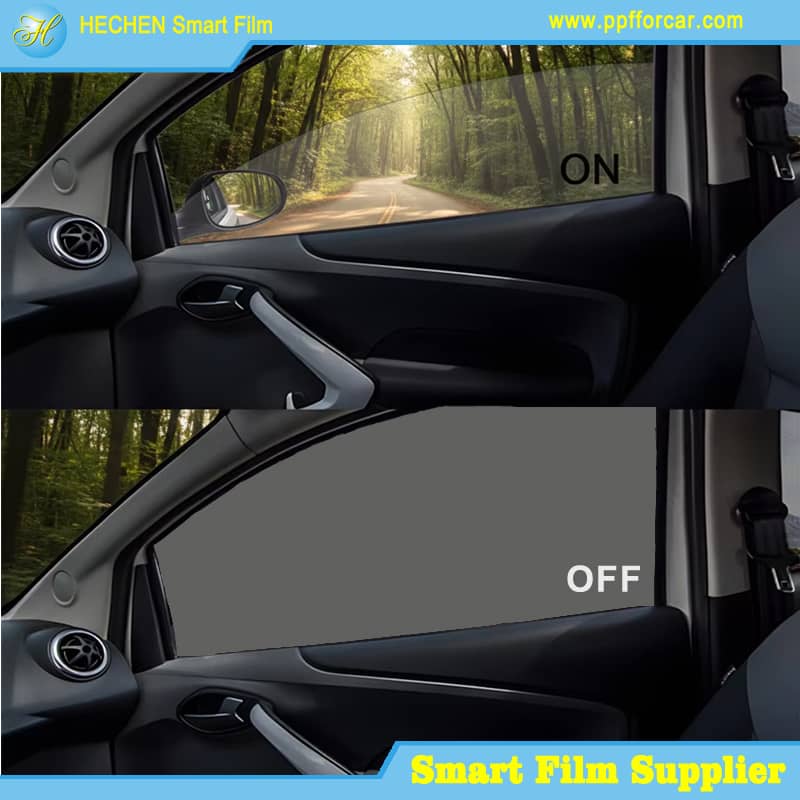
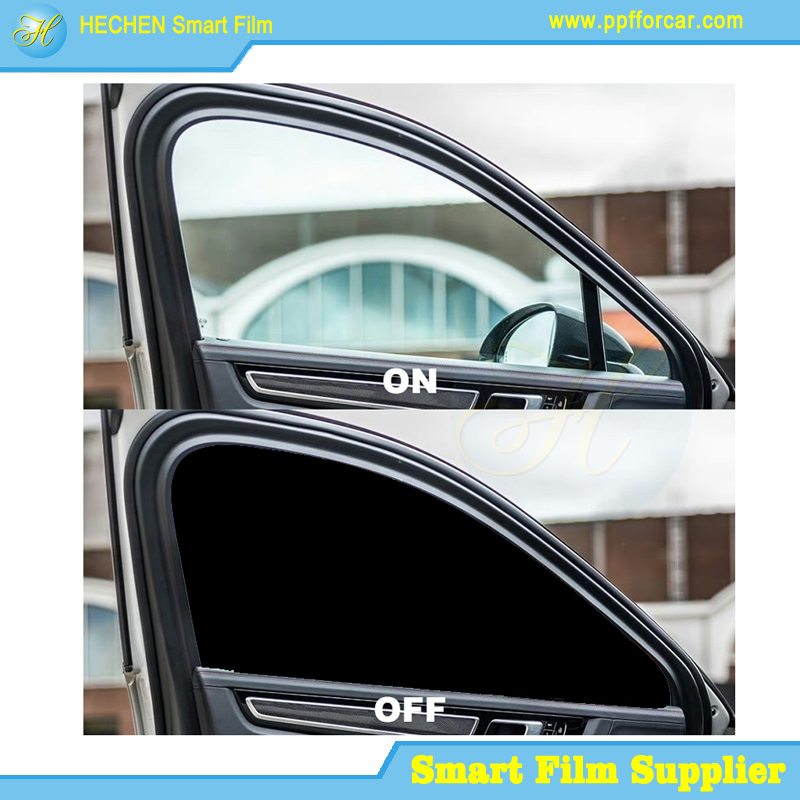
In its resting (unpowered) state, the liquid crystal droplets are randomly oriented, causing incident light to scatter in multiple directions and rendering the film a translucent, milky white appearance. When an alternating current voltage is applied across the ITO electrodes, the resulting electric field aligns the liquid crystal molecules uniformly along the field direction, allowing light to pass through with minimal scattering—making the film transparent.
3. How Does PDLC Film Work?
3.1 The Microscopic Mechanism
The optical behavior of PDLC film is governed by refractive index mismatch. Liquid crystal molecules possess two refractive indices: an ordinary index (n_o ≈ 1.5) and an extraordinary index (n_e ≈ 1.7). The surrounding polymer matrix is formulated to match the ordinary index. In the off-state (no voltage), the randomly oriented liquid crystal droplets present a continuously varying refractive index to incident light, causing strong Mie scattering. The film appears opaque or “frosted” with haze levels exceeding 90%. In the on-state (voltage applied), the aligned liquid crystals present their extraordinary index, which now matches the polymer matrix, eliminating refractive index discontinuities and allowing light to pass through unimpeded.
3.2 Electrical Requirements
PDLC film requires AC voltage for operation, typically between 40 and 70 V AC at 50 or 60 Hz. This is because DC voltage can induce electrochemical degradation of the liquid crystal layer over time. Automotive electrical systems supply 12 V DC, necessitating a small inverter or driver module that converts vehicle power to the required AC voltage. Power consumption is remarkably low: in the transparent (ON) state, the film consumes approximately 3 to 6 watts per square meter. In the opaque (OFF) state, power consumption is zero. For a typical passenger car sunroof of 1 m², this translates to less than 6 watts when transparent—comparable to a single LED interior light.
3.3 Switching Speed
Switching times for PDLC film are exceptionally fast. The transition from opaque to transparent (OFF→ON) typically occurs within 10 to 100 milliseconds; the reverse transition (ON→OFF) is even faster, often below 20 milliseconds. Some advanced formulations achieve OFF→ON switching in as little as 5 milliseconds. This near-instantaneous response enables real-time adaptation to changing lighting conditions, such as a sudden glare from the sun entering a side window.
4. Technical Specifications for Automotive Use
4.1 Key Performance Parameters
| Parameter | Typical Range |
|---|---|
| Operating voltage | 40–70 V AC |
| Power consumption (ON state) | 3–6 W/m² |
| Switching time (OFF→ON) | 10–100 ms |
| Switching time (ON→OFF) | <20 ms |
| Visible transmittance (ON) | 70–85% |
| Visible transmittance (OFF, diffuse) | 55–65% |
| OFF-state haze | >90–95% |
| ON-state haze | <5–6% |
| UV blocking | >99% |
| IR blocking (heat) | 60–90% depending on formulation |
| Operating temperature range | –30°C to +70°C (extended versions: –40°C to +90°C) |
| Viewing angle | >140° |
| Lifespan | >50,000 switching cycles |
4.2 Temperature Considerations
Automotive environments impose severe thermal demands. Interior cabin temperatures can exceed 70°C on a hot summer day, while cold climates may subject glass surfaces to –30°C or lower. Standard PDLC films are rated for –20°C to +60°C, but automotive-grade (OEM) formulations extend this range to –30°C to +70°C or even –40°C to +90°C. At low temperatures, switching speed may slow, but the film continues to function. At elevated temperatures, the liquid crystal layer remains stable provided the glass unit is properly sealed against moisture ingress.
5. Key Benefits of PDLC Film in Automotive Applications
5.1 Instant, On-Demand Privacy
The most compelling feature of PDLC film is its ability to provide instant visual privacy without mechanical sunshades or curtains. When the vehicle is parked in a public area, the driver can switch side windows or the sunroof to the opaque state, concealing valuables and passengers from outside view. For executive vehicles and limousines, PDLC privacy partitions between the front and rear compartments offer discretion for VIP passengers. Unlike traditional window films, which permanently darken the glass, PDLC film preserves the ability to enjoy unobstructed views and natural light when transparency is desired.
5.2 Solar Heat Reduction and Glare Control
PDLC film delivers substantial thermal management benefits, particularly important for vehicles with large glass areas such as panoramic sunroofs. The film blocks over 99% of harmful ultraviolet (UV) radiation in both transparent and opaque states, protecting both occupants and interior upholstery from UV-induced fading and degradation. Infrared (IR) blocking—the primary mechanism for heat rejection—ranges from 60% to over 90% depending on the specific film formulation and whether additional IR-reflective nano-coatings are integrated.
In the opaque state, the scattering effect creates a highly diffuse reflective surface, bouncing a significant portion of solar energy (including visible light and infrared) back outward rather than allowing it to pass into the cabin. This reduces solar heat gain, lowers peak cabin temperatures, and decreases the load on the vehicle’s air conditioning system—contributing to improved energy efficiency in electric vehicles. Independent tests indicate that PDLC smart film can block up to 70% of solar heat, substantially reducing the “greenhouse effect” that makes parked cars unbearably hot in summer.
Glare reduction is another significant advantage. In the opaque state, PDLC film scatters direct sunlight, transforming harsh, directional glare into soft, diffuse illumination that reduces eye strain for both drivers and passengers.
5.3 UV Protection and Interior Preservation
UV radiation is a major contributor to interior material degradation—leather cracking, fabric fading, and dashboard discoloration. PDLC film provides >99% UV blockage across the entire UVA and UVB spectrum, regardless of whether the film is in the transparent or opaque state. This passive UV protection functions continuously, unlike mechanical sunshades that require manual deployment and may leave gaps.
5.4 Acoustic Insulation (Indirect)
While PDLC film itself does not actively provide acoustic insulation, the laminated glass construction commonly used for OEM PDLC applications incorporates acoustic PVB (polyvinyl butyral) interlayers. These interlayers, combined with the PDLC layer, can enhance sound transmission loss, reducing road noise intrusion and improving cabin quietness—a valuable benefit for premium vehicles.
5.5 Aesthetic and Design Flexibility
PDLC film enables innovative design possibilities. It eliminates the need for mechanical sunroof shades, freeing up headroom—some implementations achieve up to 45 mm of additional interior space. The film can be applied to curved glass surfaces, and advanced formulations allow for segmented or multi-zone control, where different regions of a panoramic roof can be switched independently—passengers on the left side can enjoy transparency while those on the right side prefer privacy.
5.6 Explosion-Proof Safety
PDLC film, when laminated between glass layers, contributes to the safety glass construction. In the event of glass breakage, the laminated structure retains shattered fragments, preventing them from becoming dangerous projectiles inside the cabin. This explosion-proof property enhances occupant safety during collisions or break-in attempts.
6. Installation Methods: OEM vs. Aftermarket
6.1 OEM (Original Equipment Manufacturer) Integration
In factory installations, PDLC film is laminated between two layers of tempered or annealed glass during the glass manufacturing process. The resulting laminated smart glass unit is fully sealed, protected from moisture and mechanical damage, and integrated directly into the vehicle’s electrical system. OEM installations are typical for panoramic sunroofs, rear windows, and privacy partitions in luxury and electric vehicles. They offer superior durability, optical performance, and warranty coverage. Several national and international standards now govern the certification of PDLC automotive glazing, including China’s GB/T 46023.2-2025 and international regulations such as ECE R43 for safety glazing materials.
6.2 Aftermarket Retrofit Installation
For vehicles not originally equipped with smart glass, retrofit PDLC films are available as self-adhesive kits. These films are applied to the interior surface of existing glass, similar to conventional window tinting. Electrical connections are made via thin busbars attached to the film edges, which are then wired to an inverter and control switch connected to the vehicle’s 12 V electrical system. While aftermarket kits offer a cost-effective upgrade path, they present certain challenges: bubble formation during application, exposed wiring, potential edge peeling from moisture ingress, and variable quality and warranty support.
6.3 Power Integration and Control
Proper electrical integration is critical for reliable PDLC film operation. The installation requires:
An AC inverter/driver to convert 12 V DC to 40–70 V AC
Appropriate fuse protection
Concealed wiring (or surface-mounted raceways)
A user control interface: physical switch, remote control, smartphone app, or integration with the vehicle’s infotainment system
Control can be manual (momentary or latching switches), automatic (linked to ambient light sensors, occupancy detection, or ignition state), or voice-activated through smart assistants.
7. PDLC vs. Alternative Smart Glass Technologies
PDLC is one of several electrochromic technologies available for automotive glazing, each with distinct characteristics:
PDLC (Polymer Dispersed Liquid Crystal): Earliest to market, most mature, and lowest cost. Offers fast switching (milliseconds), binary (opaque/transparent) operation, and a milky white opaque appearance. Best suited for privacy applications where rapid response is valued.
SPD (Suspended Particle Devices): Requires higher voltage (≈110 V AC) and higher power consumption. Provides continuous dimming from clear to dark, offering superior glare control and a dark, neutral tint. Primarily used in high-end luxury vehicles due to higher cost.
EC (Electrochromic): Uses electrochemical reactions to change tint gradually. Offers continuous dimming, extremely low power consumption (<0.5 W/m²), and neutral dark tints with very low haze (<1%). Switching is slow (tens of seconds to minutes). Increasingly adopted in electric vehicles for its energy efficiency and aesthetic appeal.
PDLC remains the preferred choice for applications prioritizing instant switching, simple binary privacy control, and cost-effectiveness.
8. Limitations and Challenges
Despite its advantages, PDLC film has several limitations for automotive use:
Transparent-state haze: Even in the ON state, PDLC film retains a slight haze (typically 3–6%), which some users perceive as a subtle “milky” quality compared to clear glass. Advanced formulations have reduced ON-state haze to below 3%.
Binary operation: Traditional PDLC films offer only two states—fully transparent or fully opaque—without intermediate dimming levels. This limits fine-tuned light control compared to SPD or EC technologies.
Heat rejection limits: While PDLC blocks UV effectively, its solar heat gain reduction in the transparent state is limited. For optimal thermal performance, PDLC is often combined with IR-reflective coatings or low-emissivity layers.
Durability concerns: Prolonged exposure to UV radiation can degrade the PDLC polymer matrix over time, leading to yellowing or increased haze. OEM-grade films incorporate UV-absorbing interlayers to mitigate this.
Temperature sensitivity: Extreme cold slows switching response; extreme heat (above 70–90°C) can accelerate degradation if the film is not properly protected.
9. Future Developments
The PDLC industry continues to evolve with several promising innovations:
Dye-doped PDLC (DPDLC): Incorporates dichroic dyes to achieve dark, neutral-tone opaque states instead of the traditional milky white appearance. This improves aesthetic integration with vehicle interiors and offers wider viewing angles.
Multi-zone control: Advanced driver electronics enable segmented control of large glass surfaces, allowing different regions of a sunroof to be switched independently—passengers can customize their own overhead lighting and privacy.
Lower-voltage operation: Development of PDLC films that operate at 12–24 V DC would eliminate the need for AC inverters, simplifying integration and reducing system cost.
Enhanced IR rejection: Integration of spectrally selective nano-coatings and IR-reflective layers to achieve >90% total solar heat rejection while maintaining high visible transparency in the ON state.
10. Key Takeaways
Working principle: PDLC film switches between transparent and opaque states by aligning liquid crystal droplets with an applied AC voltage (40–70 V), exploiting refractive index mismatch. Power consumption is only 3–6 W/m² in the transparent state and zero in the opaque state.
Core benefits: Provides instant on‑demand privacy (>90% haze when off), blocks >99% of UV radiation, reduces solar heat gain by up to 70%, and transforms direct glare into soft diffuse light—all without mechanical shades.
Technical specifications: Switching time of 10–100 ms, visible transmittance of 70–85% (on‑state) and 55–65% diffuse (off‑state), automotive‑grade temperature range from –30°C to +70°C (or wider), and lifespan exceeding 50,000 switching cycles.
Installation options: OEM laminated glass offers superior durability and seamless integration; aftermarket adhesive films provide a retrofit path but may have exposed wiring and reduced longevity.
Limitations: Slight haze remains in the transparent state (typically 3–6%); binary on/off operation only (no continuous dimming); limited solar heat rejection in transparent mode; temperature extremes affect performance.
Future direction: Dye‑doped formulations for neutral‑tone opacity, multi‑zone control, lower‑voltage DC operation, and enhanced infrared rejection are advancing PDLC toward broader automotive adoption.
Conclusion
PDLC smart film represents a transformative technology for automotive glazing, offering instant, electrically switchable privacy, effective UV and IR radiation control, glare reduction, and significant thermal management benefits. Its core principle—aligning liquid crystal droplets within a polymer matrix via an applied electric field—enables near-instantaneous transitions between transparent and opaque states. With low power consumption (3–6 W/m² in the ON state), fast switching speeds (milliseconds), and compatibility with both OEM laminated glass and aftermarket retrofit installations, PDLC film is increasingly specified in sunroofs, side windows, and privacy partitions across passenger vehicles, luxury sedans, and commercial fleets. While alternative technologies such as SPD and EC offer different trade-offs in dimming range, switching speed, and power consumption, PDLC remains the most mature, cost-effective solution for applications prioritizing rapid binary privacy control. As automotive-grade formulations continue to advance—particularly in dye-doped capabilities and multi-zone control—PDLC technology is poised to become a standard feature in the next generation of intelligent vehicle glazing systems.
For more about PDLC Film for Cars: What Is It and How Does It Work? Everything you need to know, you can pay a visit to https://www.ppfforcar.com/product/PDLC-Smart-Film/ for more info.


评论
发表评论